
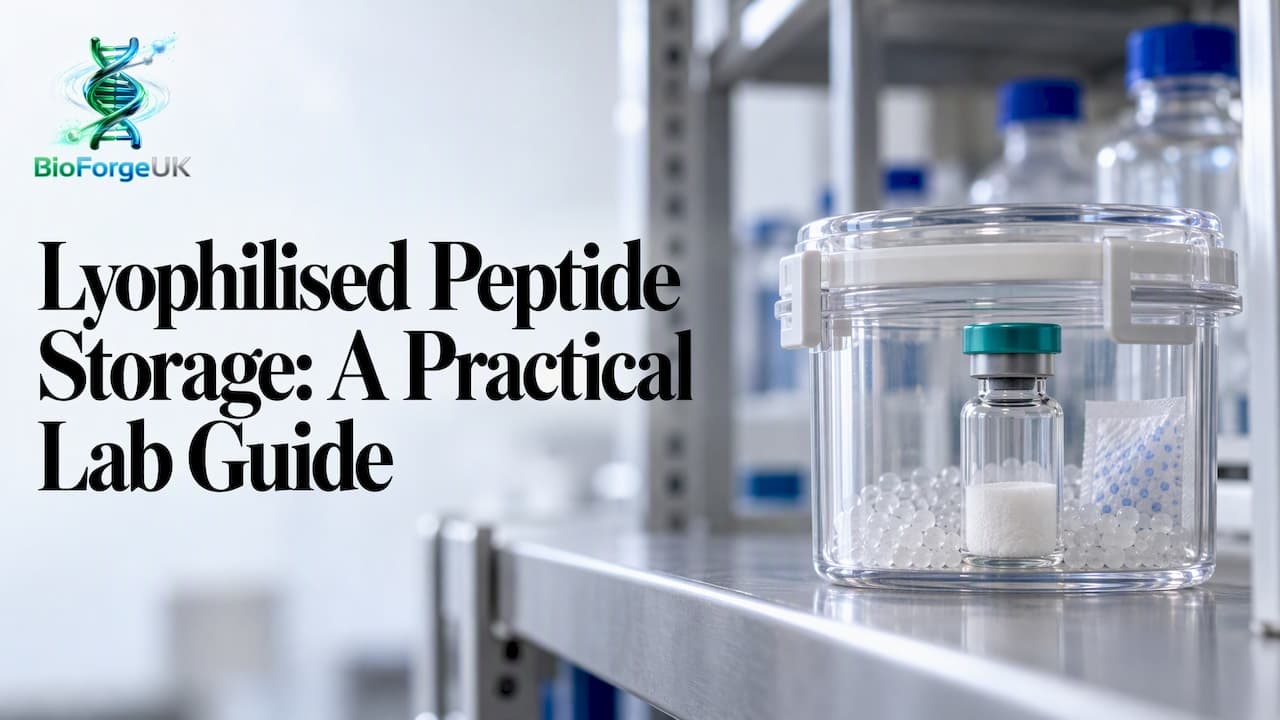
Store lyophilised peptides cold, dry, dark and tightly sealed. For anything you will not use within weeks, that means a freezer at -20°C or colder, with the vial allowed to reach room temperature before you open it. Most degradation happens through moisture, repeated warming and light, not through the freeze-dried powder simply sitting there. This guide covers what to do on the day a vial arrives, how long each storage tier is realistic, and the handling mistakes that cost labs good material.
Everything below applies to research peptides used in laboratory work only.
TL;DR
- Long-term: keep sealed lyophilised vials at -20°C, or -80°C for sequences you want to protect for years. A refrigerator (2-8°C) is for short holding periods.
- Let the vial warm to room temperature, unopened, before you break the seal. Cold glass opened in humid air pulls water into the powder.
- Protect from light and moisture: tight cap, dark box, desiccant where you can.
- Weigh out or reconstitute what you need once, then aliquot. Repeated freeze-thaw cycles and repeated opening are the main avoidable losses.
- Stability is sequence-dependent. Methionine, cysteine, tryptophan, asparagine and glutamine residues need extra care.
Table of Contents
- Why lyophilised peptides keep so well
- Storage conditions by time frame
- What to do the day a vial arrives
- Moisture: the main enemy
- Light and oxygen
- Freeze-thaw cycles, aliquots and solutions
- Room temperature: how much is too much?
- Common mistakes
- Our perspective
- Buying with storage in mind
- A simple storage checklist for your lab
- FAQ
- Sources
Why lyophilised peptides keep so well
Lyophilisation, or freeze drying, removes water from a product at low temperature by sublimation and desorption. The product is frozen first, then dried under vacuum. Removing water matters because water drives most of the chemistry that breaks peptides down: hydrolysis of the backbone, deamidation of asparagine and glutamine, and aggregation.
That is why a dry powder can sit for months or years while the same peptide in solution may last days. It is also why moisture is the thing to guard against once the vial is in your hands. A lyophilised peptide that has taken up water has, in effect, lost part of what the freeze drying achieved.
The same formulation literature points out that stability is not set by the amino acid sequence alone. Bulking agents and protective excipients such as mannitol, trehalose and sucrose help maintain structural integrity through both freeze drying and storage. Two peptides in identical vials can therefore behave differently on the shelf.
Storage conditions by time frame
The published guidance from research institutions and suppliers is consistent in direction, with some variation in the numbers. The table below sets out sensible working tiers.
| Time frame | Where | Notes |
|---|---|---|
| Days to a couple of weeks | Room temperature, cool, dark, sealed | Acceptable for transit and brief bench handling, not as a storage plan |
| Weeks to a few months | Refrigerator, 2-8°C | Dry, sealed, away from light. Fine for a working vial |
| Months to years | Freezer, -20°C | The standard for long-term storage of lyophilised material |
| Years, or sensitive sequences | -80°C | Extra margin for peptides prone to oxidation or deamidation |
The UK's National Institute for Biological Standards and Control advises that peptides should be kept in a dry, cool, dark place, at 4°C or colder and away from bright light for best preservation. It adds that dry peptides tolerate room temperature for days to weeks, while -20°C is the choice for long-term storage.
You will see shelf-life figures quoted from a few months to several years. Treat them as ranges, not guarantees. A peptide with no oxidation-prone residues, stored at -20°C and never opened in humid air, will outlast the same peptide handled carelessly at -80°C.
What to do the day a vial arrives
Lyophilised peptides are physically robust enough for ordinary ambient transit, which is measured in days. Arrival is where your handling starts to matter more than the courier's.
- Inspect the vial. Check the seal, the label against your order and the appearance of the cake. A freeze-dried peptide is usually a fluffy or compact white solid. Some collapse or shrink slightly in transit, which does not by itself indicate a problem.
- Check the paperwork. Match the batch number on the vial to the Certificate of Analysis, and file the CoA with your records. The purity figure and the analytical method are your baseline if results ever look odd later.
- Move it to cold storage promptly. Do not leave the box on a warm bench while you finish another task. Time spent at room temperature before freezing is cumulative stress, and it is one of the more common sources of avoidable degradation after delivery.
- Log it. Record date received, storage location, planned use and who has opened it.
- Store in a secondary container. A labelled, lidded box with a desiccant sachet protects against light, condensation and accidental knocks.
If you intend to use the peptide within a few weeks, a refrigerator is reasonable. If there is any doubt, freeze it.
Moisture: the main enemy
Many lyophilised peptides are hygroscopic, and some, notably those rich in charged residues, take up water from the air quickly. Three habits do most of the work.
Equilibrate before opening. Take the vial from the freezer or fridge and leave it sealed on the bench until it reaches room temperature. Depending on vial size, that is typically 20 to 30 minutes. Open a cold vial and atmospheric moisture condenses on the powder. The NIBSC and major reagent handling guides give the same instruction, and it costs nothing.
Keep the cap tight, always. The vial should be closed whenever you are not actively taking material out of it.
Use a desiccator or desiccant. For vials you will access more than once, a sealed container with silica gel gives a drier micro-environment inside the freezer. Freezers cycle through defrost routines, and frost-free models can warm briefly. A secondary container smooths that out.
If you must open the vial repeatedly, consider flushing the headspace with dry nitrogen or argon before re-sealing. That is particularly useful for peptides containing methionine, cysteine or tryptophan.

Light and oxygen
Bright light accelerates oxidation of susceptible residues, so store vials in the dark, whether in a box, an opaque bag or an amber container. Oxidation is the other big route of loss. Methionine is the textbook example, and cysteine can form disulfide-linked dimers. The Klarovel storage guide summarises the formulation literature on aggregation, deamidation and oxidation as the most common degradation routes, which is a useful checklist when you look at a sequence.
A quick sequence check before you decide where a peptide lives:
- Met, Cys, Trp: oxidation-prone. Prefer -80°C or inert gas for long storage, and minimise air exposure.
- Asn, Gln: deamidation-prone, especially once in solution at neutral or higher pH.
- Asp-Pro or Asp-Gly sequences: can be labile to hydrolysis.
- Hydrophobic or highly charged sequences: may be hygroscopic or prone to aggregation.
Freeze-thaw cycles, aliquots and solutions
Once a peptide is in solution, the rules change. Solutions are far less stable than the dry powder, and each freeze-thaw cycle adds stress. The practical approach is:
- Decide how many experiments the vial will serve.
- Reconstitute once, in the solvent your protocol specifies, using sterile technique.
- Divide into single-use aliquots sized for one experiment.
- Freeze the aliquots promptly, and discard leftovers rather than refreezing them.
Where you can, weigh the dry powder into separate tubes instead of storing a stock solution. Dry aliquots at -20°C keep better than frozen solutions, though you accept a small weighing error and a short exposure to air. Weigh quickly, in a low-humidity environment if you have one, and reseal the parent vial straight away.
Solution storage is a separate topic with its own variables: pH, buffer, whether sterile filtration is needed, and the peptide's sequence. As a rule of thumb, slightly acidic, sterile buffers are gentler than basic ones, and your protocol or the peptide's data sheet should decide the details.
Room temperature: how much is too much?
Readers often ask how long a vial can sit out. There is no single answer, because it depends on the sequence. NIBSC describes dry peptides as stable at room temperature for days to weeks. Published stability studies have shown many peptides surviving much longer at ambient temperature, but those results are sequence-specific and nobody recommends planning around them.
The sensible stance:
- A few days at ambient temperature in transit is not a concern for a sealed lyophilised vial.
- A few hours on the bench during a working session is fine if the vial stays sealed and dry.
- Weeks on a shelf is a gamble. Months is a bad idea.
- Warm, humid or sunlit rooms change all of this. A cool, dark cupboard is not a sunny windowsill.
What about refrigeration? A fridge is a perfectly good middle tier, but it is not a substitute for a freezer when you are holding material for many months. Equally, do not assume a peptide is spoiled just because it sat in a fridge instead of a freezer for a few weeks. Compare against your CoA and, if the work is critical, re-verify by HPLC or mass spectrometry.
Common mistakes
- Opening a cold vial. Condensation is the fastest way to wet a dry powder.
- Storing in a frost-free freezer door. The door sees the biggest temperature swings. Use a stable shelf towards the back.
- Thawing and refreezing stock solution. Aliquot instead.
- Poor labelling. A vial without batch, date and sequence name is a data integrity problem. Keep the CoA linked to the batch.
- Ignoring the sequence. One storage rule for every peptide is convenient, but oxidation-prone sequences deserve better.
- Mixing storage with open food or reagent areas. Keep research peptides in a labelled, controlled location under your institution's chemical handling procedures.
Our perspective
We supply research peptides at 99%+ HPLC purity, and we have seen the same pattern many times: purity on the certificate is only half of the story. A high-purity peptide handled badly will perform worse than a lower-purity one handled well, which is why we think of storage as the second half of quality control.
We put the Certificate of Analysis at the centre of this. It is your baseline. When something looks off in an assay, the first question is whether the batch has changed since it was verified, and that question is only answerable if you recorded how the material was stored and handled. So our advice is simple: log what you receive, freeze what you will not use soon, equilibrate before opening and aliquot early.
We also keep our own position clear. Our peptides are supplied for laboratory and scientific research only, not for human or veterinary consumption, and we expect storage and handling to take place under the controls of a proper research setting.
— Neil
Buying with storage in mind
When you order, think about quantity in terms of how you will store it. A single large vial opened ten times is a worse proposition than smaller amounts opened once each. Ask whether the supplier provides a batch-specific CoA with the analytical data, and keep it with the vial.
BioForgeUK supplies research peptides at 99%+ HPLC purity, backed by quality controls, verification and detailed product certification, with a secure checkout. You can read how we define permitted use on our Research Use Only page, or browse the range from the BioForgeUK homepage.
A simple storage checklist for your lab
Print it, pin it by the freezer, adapt it to your SOP.
- Receive, inspect and match batch to CoA.
- Log date, location and user.
- Move to -20°C (or -80°C for sensitive sequences) in a dark, sealed secondary container with desiccant.
- Before use, equilibrate the sealed vial to room temperature.
- Open briefly, take what you need, flush with inert gas if appropriate, reseal and return.
- Aliquot solutions into single-use volumes and never refreeze leftovers.
- Review stock at set intervals and retire anything past your own stability limit.
FAQ
How long do lyophilised peptides last at room temperature?
For sealed, dry vials, days to weeks is the usual guidance, and NIBSC describes it that way. Some sequences last far longer, but that is sequence-dependent and long-term room temperature storage is not recommended. Heat, humidity and light shorten the time.
What happens if I do not refrigerate my peptides?
A sealed lyophilised vial left out briefly is unlikely to be harmed, because the dry state protects it. Over weeks and months, moisture uptake, oxidation and deamidation add up, and the peptide's purity can fall. If you are unsure, check the batch against its Certificate of Analysis.
Is -20°C or -80°C better for lyophilised peptides?
Both work. -20°C is the standard for long-term storage of most sequences, while -80°C gives extra margin for peptides with oxidation-prone residues or for very long holding periods. Avoiding moisture and freeze-thaw cycles matters more than the difference between the two temperatures.
Why must I let the vial warm up before opening it?
A cold vial opened in room air collects condensation, and the powder is often hygroscopic. That water starts the degradation chemistry that freeze drying was meant to prevent. Leave the vial sealed until it reaches room temperature, then open it.