
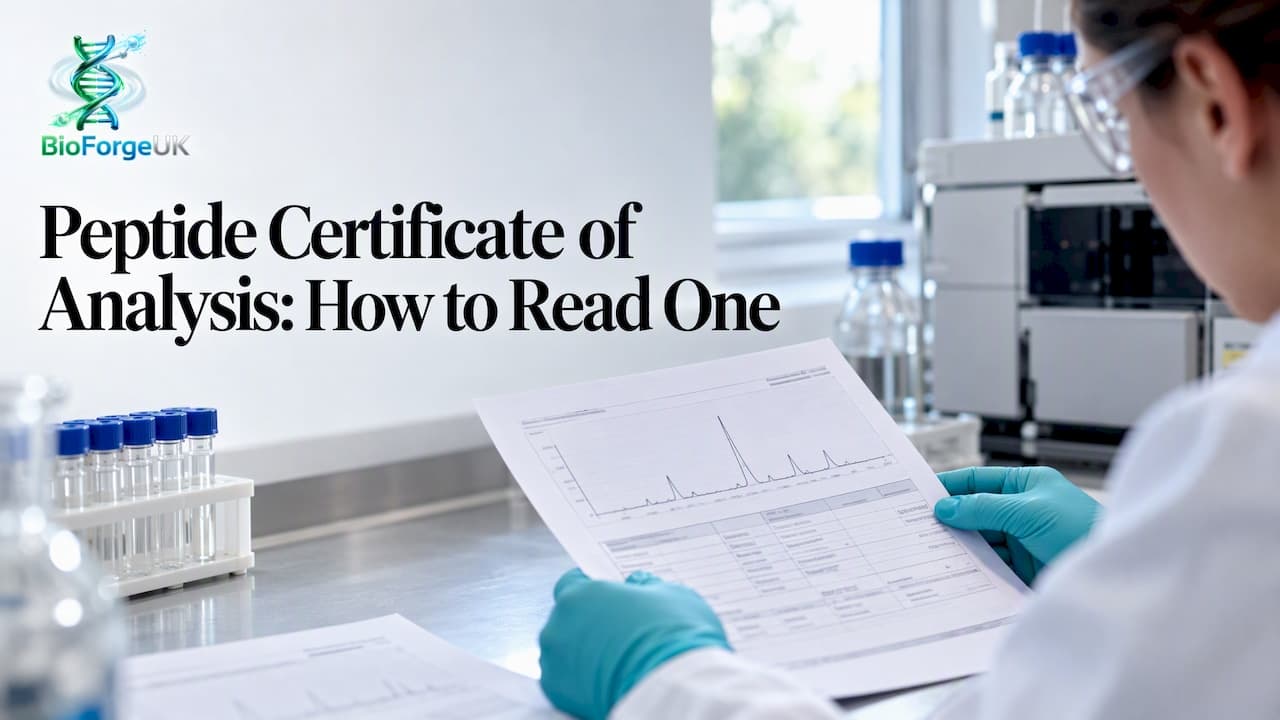
A peptide certificate of analysis (COA) is a batch-level record of the tests run on one specific lot: which methods were used, on what date, by which laboratory, and what the results were. It is useful only if it belongs to the vial on your bench, was issued by a laboratory you can check, and shows enough raw detail for you to judge the result yourself. This guide walks through each of those tests, in the order we would run them if a COA landed on our desk.
Everything here is written for laboratory and research readers. Research peptides are supplied for in vitro and laboratory work only, not for human or veterinary consumption.
TL;DR
- A COA describes one lot. A certificate for a different batch number tells you nothing about the material you hold.
- Look for two separate answers: HPLC for purity (how much of the sample is the target peptide) and mass spectrometry for identity (whether it is the right molecule).
- Check who issued it. ISO/IEC 17025 accreditation, a report code and a verification route matter more than a polished PDF.
- Ask for the chromatogram and mass spectrum, not just a percentage. A bare "99%" with no trace is a claim, not evidence.
- Keep the COA with your lab records, filed against the lot number, so every result can be traced back later.
Table of Contents
- What a peptide COA is, and what it is not
- The sections of a peptide COA, one by one
- Who issued it matters as much as what it says
- Lot traceability: tying the certificate to your vial
- A quick checklist you can run in five minutes
- Reading a chromatogram without a chemistry degree
- When "COA" means something else
- Our perspective on certificates
- Buying research peptides with documentation you can check
- Common mistakes to avoid
- FAQ
- Sources
What a peptide COA is, and what it is not
A COA is a formal quality document. In pharmaceutical practice it is batch-specific and records test results against set specifications for purity, identity and safety. Good manufacturing practice guidance for certificates lists the elements a proper one carries: the laboratory name and address, a document serial number, the batch number, relevant dates, the test procedures used, numerical results with acceptance limits, and an authorised signature.
Research-grade peptides are not made under pharmaceutical rules, so a research COA does not have to meet that template. It is still a sensible yardstick. If a certificate for research material lacks most of those elements, you have learned something about the supplier.
A COA is not:
- A guarantee of the next batch. Synthesis varies between runs, so each lot needs its own certificate.
- A statement about safety or suitability for humans. It reports analytical results on a sample, nothing more.
- A marketing badge. A logo, a green tick or a number in a banner is not a certificate.
The same guidance says a valid COA should be an original document, not a copy, and should either come from the original manufacturer or be based on the testing laboratory's own analytical worksheet. If a supplier passes on a third-party certificate, it should also carry the original manufacturer's details so the chain of custody stays clear.
The sections of a peptide COA, one by one
Most peptide certificates follow a similar layout. Here is what each part should tell you and what to be wary of.
Product and batch identification
At the top you should find the peptide name, sequence or molecular formula, the theoretical molecular weight, the lot or batch number, and the date of analysis. The lot number must match the label on your vial character for character. A certificate that gives only a product name, with no lot, cannot be tied to anything.
Purity by HPLC
Reversed-phase HPLC separates the sample by hydrophobicity. The target peptide appears as a main peak, and purity is the area of that peak as a share of all peaks in the trace. A result such as 99.2% means the main peak accounts for 99.2% of the integrated area at the detection wavelength used.
Two cautions. First, area percentage is not the same as the true mass of peptide in the vial (more on that under net peptide content below). Second, the figure depends on the method. A gradient that is too steep can hide closely eluting impurities inside the main peak, which flatters the number.
The method details should be on the certificate: column type, mobile phases, gradient, flow rate, detection wavelength (peptide bonds are commonly read at around 214 to 220 nm) and run date. Method choice is not trivial. An AQbD-based study of triptorelin found its best results by tuning column chemistry, gradient and temperature for that specific peptide, using a C18 column at 53.8 °C, rather than relying on a generic protocol.
Column choice depends on the peptide. According to a peptide and protein guide from a chromatography column manufacturer, C18 is the conventional choice for smaller peptides (under roughly 2,000 to 3,000 Da), while larger or more hydrophobic molecules often do better on C4, which gives less retention and helps limit peak broadening. If a certificate shows a very broad, tailing main peak, the column or conditions may be the cause rather than the sample.
Aggregation can also distort a trace. In work on peptide-oligonucleotide conjugates, the authors found that aggregation driven by electrostatic interactions was a frequent cause of poor chromatography, and that wide-pore C18 resin and tuned mobile-phase pH helped. That is a specialised case, but the lesson carries over: an ugly peak does not automatically mean a bad peptide, and a pretty one does not automatically mean a good one.
Identity by mass spectrometry
HPLC says how much of the sample is one species. It does not say which species. A well-separated peak can be the wrong peptide, a truncated sequence or a deletion product. Mass spectrometry (ESI-MS or MALDI-TOF) measures the mass-to-charge ratio, so you can compare the observed molecular weight with the theoretical value.
What to look for:
- The theoretical mass stated next to the observed mass.
- A spectrum, not just a line of text. You should be able to see the dominant ion series and spot the charge states.
- Agreement within the tolerance of the instrument. For a typical research peptide, you would expect the deconvoluted mass to sit very close to theory.
If a COA gives purity but no identity test, it answers half the question.
Net peptide content and water
A lyophilised peptide is not 100% peptide by weight. It also holds counter-ions (often trifluoroacetate or acetate) and residual water. Net peptide content, usually measured by amino acid analysis or nitrogen analysis, tells you how much of the weighed powder is actually peptide. This matters directly for making stock solutions. If you weigh 10 mg of powder with 75% net content, you have 7.5 mg of peptide, and your molarity is out by a quarter if you ignore that.
Not every COA reports it. When it is missing, treat your concentrations as nominal, or ask the supplier whether a content figure is available for that lot.
Other tests you may see
Some certificates add endotoxin results, residual solvent data, counter-ion analysis or appearance and solubility notes. These are useful when your assay is sensitive to them, for example cell work where endotoxin can interfere. Whatever appears, each result should state the method and the specification it was tested against.
Signature, date and contact
An authorised signature or electronic approval, the analysis date and a way to contact the issuing laboratory complete the document. The date should make sense against the manufacture date of the lot. A test date months before the lot was made is a red flag.
Who issued it matters as much as what it says
A certificate is only as reliable as the laboratory behind it. Look for accreditation to ISO/IEC 17025, the international standard for the competence of testing and calibration laboratories. In the UK, UKAS accredits laboratories against that standard, and an accredited lab will normally state its accreditation and scope.
Accreditation has a scope. A laboratory can be accredited for some methods and not others, so confirm that the test on your certificate falls within it, or at least ask. Do not read a logo on a PDF as proof.
Then cross-check. Many laboratories print a report code or a verification link. Use it, and compare the batch number, date and results with what the laboratory holds. Treating any PDF labelled "COA" as authoritative is the commonest mistake.
Finally, ask whether the testing is in-house or independent. In-house testing is perfectly normal for production control, but independent testing gives a second pair of eyes. A good supplier will tell you plainly which it is for each lot.

Lot traceability: tying the certificate to your vial
Traceability is what turns a document into evidence. The chain looks like this:
- The synthesis run receives a lot number.
- Samples from that lot go for analysis, and the report cites the lot number.
- The vial label carries the same lot number.
- Your order record links your purchase to that lot.
- Your own lab notebook records the lot used in each experiment.
If any link breaks, you cannot show that the data on the certificate describes your material. Here is a practical routine:
- On receipt, photograph the vial label and file it with the COA.
- Record lot number, supplier, date received and storage conditions in your inventory.
- Write the lot number in the notebook entry for every experiment.
- If you reorder, request the new lot's certificate and compare it with the old one. Do not assume equivalence.
- When results shift unexpectedly between runs, check whether the lot changed before you chase other causes.
Some manufacturers of research reagents offer a lookup where you enter a lot number and download the matching certificate, as Bio-Techne's COA finder does. It is a good model of what lot-level access should look like, wherever you buy.
A quick checklist you can run in five minutes
| Check | What good looks like | Warning sign |
|---|---|---|
| Lot number | Matches your vial label exactly | Missing, or a different lot |
| Issuing lab | Named, with address and accreditation | No lab named, only a brand logo |
| Purity method | HPLC with column, gradient, wavelength and trace | A percentage with no chromatogram |
| Identity | Mass spectrum with observed and theoretical mass | No identity test |
| Dates | Analysis date after manufacture, before shipping | Undated, or implausible dates |
| Verification | Report code or link that checks out | Nothing to verify against |
| Content | Net peptide content or a note that it is not measured | Silence on the point |
| Consistency | Same layout and values style across lots | Identical numbers on every lot |
That last row deserves a word. Real batches vary. If every lot of every peptide from a supplier reports the same purity to the decimal, ask questions.
Reading a chromatogram without a chemistry degree
You do not need to be an analytical chemist to spot trouble. Look at the baseline first: it should be reasonably flat, with a clear, tall main peak. Check that the integration (the shaded or marked area) covers the whole peak and does not cut off a shoulder. Count the minor peaks and see where they fall: small peaks just before or after the main one often point to closely related impurities such as deletion sequences, while a cluster at the solvent front is usually injection artefacts.
Then check the axes. The x-axis should be retention time and the y-axis absorbance at a stated wavelength. If the chromatogram has no axes, no scale and no sample name, it may be a picture rather than data.
Finally, look for the integration report. A table listing every peak with retention time and area percentage is far more informative than a single purity figure, because you can see what the remaining percent is made of.
When "COA" means something else
The same three letters appear across industries, and search results mix them. In cosmetics, for instance, the safety documentation required under the UK version of Regulation (EC) No 1223/2009 is a product safety report, and its annex requires composition, physical and chemical characteristics, stability and microbiological quality, plus toxicological assessment of ingredients. That is a consumer-safety exercise. A research peptide certificate answers a narrower question: what is in this lot, by which method, and how pure is it.
Keep the two apart. A research COA is not a safety assessment and does not make a material suitable for any use outside the laboratory.
Our perspective on certificates
We supply research peptides at 99%+ HPLC purity, and we think the number on the front of a certificate is the least interesting thing about it. Anyone can print a high figure. What gives it weight is everything around it: the lot number that ties it to the vial, the method that produced it, the trace you can inspect, and a way for you to verify it.
That is why detailed certification, including Certificates of Analysis, sits at the centre of how we describe our products. Researchers have been let down often enough by vague paperwork that scepticism is the right default. We would rather you read our documentation critically, using the checklist above, than take it on trust.
Two habits we encourage in any lab, whoever the supplier. Always record the lot number in your notebook. And treat purity as one input among several: for quantitative work, think about net peptide content and storage, not only HPLC area.
We also keep the purpose of our products clear. They are for laboratory and scientific research only, and our research use only page sets out exactly what that means for buyers.
— Neil
Buying research peptides with documentation you can check
If you are sourcing peptides for the laboratory, put the certificate questions to the supplier before you order, not after delivery: is there a COA for the exact lot, which methods does it cover, and who performed the analysis? At BioForgeUK we supply precision research peptides with 99%+ HPLC purity, supported by quality controls, verification processes and Certificates of Analysis, with a secure checkout. Everything is sold strictly for laboratory research, not for human or veterinary consumption. You can browse the range at bioforgeuk.co.uk.
Common mistakes to avoid
- Accepting a generic COA. A certificate for "Peptide X" without a lot number is a product brochure.
- Confusing purity with content. 99% purity says nothing about how many milligrams of peptide are in 10 mg of powder.
- Ignoring identity. HPLC without mass spectrometry cannot tell you the peak is the right molecule.
- Skipping verification. If a report code exists, use it.
- Overlooking storage. A perfect certificate describes the sample on the test date. Poor storage afterwards can degrade the peptide, so follow the supplier's storage guidance and keep a record.
- Reusing old certificates. Reorders mean new lots, and new lots need new documents.
FAQ
What is a peptide COA used for?
It documents the tested properties of one lot, usually purity by HPLC and identity by mass spectrometry. Researchers use it to confirm the material meets the specification before an experiment and to keep a traceable record in their lab files. It supports data quality and reproducibility, and nothing beyond laboratory use.
Is HPLC purity of 99% enough on its own?
No. HPLC purity is an area percentage that depends on the method, and it does not confirm identity or tell you the peptide content by weight. You also want a mass spectrum matching the theoretical mass, the chromatogram itself and, for quantitative work, net peptide content.
How can I check that a COA is genuine?
Confirm that the lot number matches your vial, that a named laboratory issued it, and that any accreditation claimed is real and covers the method used. Use the report code or verification link if one is given, and compare the details with the laboratory's own records. A document with none of these is hard to rely on.
Do I need a new COA for every order?
Yes, if the lot has changed. Each synthesis run can differ slightly, so the certificate that applies is the one for the lot number on your vial. Keep it with your records alongside the order details.
What does ISO/IEC 17025 mean on a certificate?
It is the international standard for the competence of testing and calibration laboratories. A laboratory accredited to it has had its technical competence assessed, but accreditation is limited to a defined scope, so check that the specific test is covered.
Sources
- Template for certificate of analysis, based on GMP good practice
- AQbD-based stability-indicating UHPLC method for triptorelin, Analytical Methods (RSC)
- Avantor ACE peptide and protein guide
- High-resolution HPLC for separating peptide-oligonucleotide conjugates, PMC
- UKAS laboratory accreditation publications
- Bio-Techne certificate of analysis finder tool
- Cosmetic product safety report annex, legislation.gov.uk