
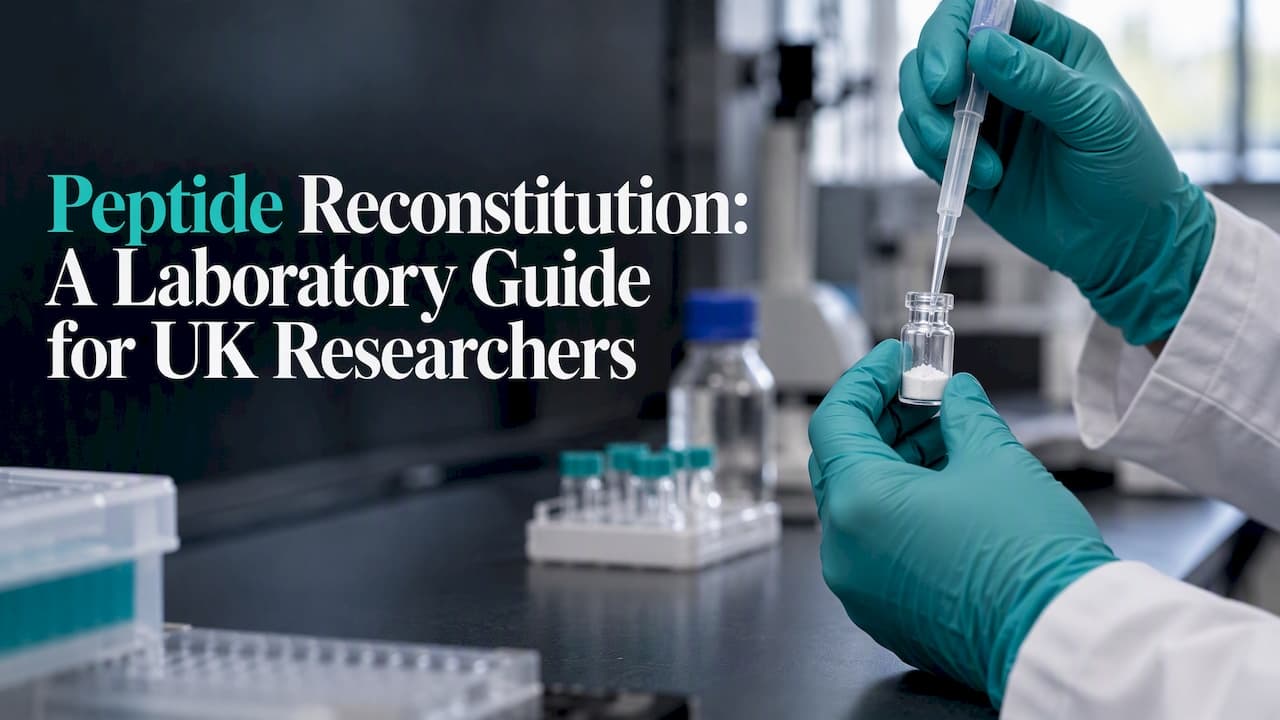
Reconstituting a peptide means dissolving a freeze-dried (lyophilised) powder in a measured volume of solvent, so you end up with a stock solution of known concentration. Do it well and your assays are reproducible. Do it badly and you get aggregation, lost material or a concentration that is wrong from the start. This guide covers the laboratory workflow: preparing the vial, choosing a solvent, calculating concentration from the Certificate of Analysis (CoA), mixing gently, aliquoting and storing.
Everything here applies to research peptides used in vitro or in other laboratory work. It is not guidance for preparing anything for human or animal use, and we do not supply peptides for that purpose.
TL;DR
- Let the sealed vial reach room temperature before you open it, so moisture does not condense on the powder.
- Calculate concentration from the net peptide content on the CoA, not the gross weight on the label. Net content is often well below 100%.
- Add solvent slowly down the vial wall and swirl or rock gently. Do not shake or vortex hard.
- Divide the stock into single-use aliquots and keep them frozen, away from repeated freeze-thaw cycles.
- Label every tube with peptide, lot, concentration, solvent and date, and keep the CoA with your records.
Table of Contents
- What happens to a peptide during lyophilisation and reconstitution
- Before you open the vial
- Choosing a solvent
- Work out the concentration from the CoA, not the label
- Step-by-step: reconstituting a lyophilised peptide
- When the peptide will not dissolve
- Aliquoting and storing the stock
- Common mistakes we see
- Our perspective: reconstitution starts with the paperwork
- Sourcing peptides for the lab
- FAQ
- Sources
What happens to a peptide during lyophilisation and reconstitution
Lyophilisation removes water under vacuum from a frozen solution and leaves a dry "cake" that is stable for storage and shipping. The cake is a snapshot of the peptide's state at the moment of drying. Research on freeze-dried peptide products notes that freezing and drying stresses can cause irreversible aggregation and subvisible particles, and that how you reconstitute matters for keeping the peptide's structure intact.
In practice, that gives you three goals at the bench:
- Keep water out of the powder until you are ready to dissolve it.
- Dissolve it completely, with as little mechanical stress as possible.
- Know exactly how much peptide is in how much liquid.
The rest of this guide follows those three goals in order.
Before you open the vial
Equilibrate to room temperature
A cold vial opened in a warm lab pulls in humid air, and that moisture condenses on the powder. Many peptides are hygroscopic, so they turn sticky and become hard to recover. The USP's best-practice infographic for reconstituting peptide reference standards recommends letting the vial equilibrate to room temperature for 15 to 30 minutes before opening. If you have a desiccator, let the vial warm inside it.
Collect the powder at the bottom
Lyophilised cakes can loosen in transit and cling to the stopper or the upper wall. Tap the vial gently, upright, on the bench so everything sits at the bottom before you break the seal. The same USP guidance makes this point. Do not bang it hard enough to crack the glass or fragment the cake into dust.
Gather your materials
- The vial and its CoA, with the lot number matching
- Your chosen solvent, at room temperature
- Calibrated pipettes and sterile, low-bind tips
- Low-protein-binding microcentrifuge tubes for aliquots
- Gloves, a clean bench or laminar flow cabinet if your protocol requires sterility, and a permanent marker or pre-printed labels
- A calculator or spreadsheet with the formula already written down
Choosing a solvent
There is no single correct solvent. The right one depends on the peptide's sequence and charge, what your assay tolerates, and how long you need the stock to last. Your supplier's data sheet and the peptide's published literature are the first places to look.
A few general principles:
- Start with sterile water or a sterile buffer. Many short, hydrophilic peptides dissolve readily this way. For storing solutions, the UK's National Institute for Biological Standards and Control (NIBSC) advises sterile buffers at a pH of around 5 to 6 to prolong the life of peptides in solution.
- Check your assay's tolerance for preservatives. Some protocols use bacteriostatic water, which is sterile water with a preservative, to keep multi-use stocks clean. Cell-based work and sensitive enzyme assays may not tolerate preservatives, so confirm this before you commit the whole vial.
- Hydrophobic sequences may need an organic co-solvent. Where water alone fails, labs typically dissolve the peptide in a minimal volume of a suitable organic solvent first, then dilute with aqueous buffer. Follow the supplier's solubility guidance for that specific sequence rather than improvising.
- Test on a small amount first. If you have spare material, trial the solvent on a small portion of the powder before you dissolve the whole lot. This is slower, but it protects an expensive, irreplaceable vial.
Whichever solvent you choose, write it on the tube. A stock that nobody can identify six weeks later is worse than no stock.
Work out the concentration from the CoA, not the label
This is the step where most reproducibility problems begin. The mass printed on the vial label is the gross mass of the powder. That powder is not all peptide. It also contains counter-ions (for example, trifluoroacetate left over from purification) and residual moisture.
Bachem's care and handling guidance explains that net peptide content is rarely 100% of the gross mass and typically falls between 60% and 90%. For accurate concentrations, base your calculation on the peptide mass stated on the CoA.
Note also that HPLC purity and net peptide content are different things. A product can be 99%+ pure by HPLC, meaning almost all of the peptide-related material is the target sequence, and still be only 75% peptide by weight because of counter-ions and water. Both numbers belong on your CoA, and you need both.

The formula
Concentration (mg/mL) = (vial mass in mg × net peptide content) ÷ solvent volume in mL
A worked example
Suppose a vial is labelled 5 mg and the CoA gives a net peptide content of 80%.
- Net peptide mass: 5 mg × 0.80 = 4 mg
- You add 2 mL of solvent.
- Concentration: 4 mg ÷ 2 mL = 2 mg/mL, which is 2,000 µg/mL
If you had used the gross 5 mg instead, you would have calculated 2.5 mg/mL. That is a 25% error before you have run a single experiment.
Now suppose your assay needs a working solution of 100 µg/mL made from this stock. Use C1V1 = C2V2:
- 2,000 µg/mL × V1 = 100 µg/mL × 1,000 µL
- V1 = 50 µL of stock, made up to 1,000 µL with buffer
Choosing a stock concentration
A more concentrated stock saves freezer space and lets you pipette larger, more accurate volumes of diluent. A more dilute stock reduces the risk of aggregation for sequences that are prone to it. As a rule of thumb, pick a volume that lets you pipette comfortably in the range of your pipettes. Measuring 2 µL with a P10 is more error-prone than measuring 20 µL with a P20.
| Gross vial mass | Net content (from CoA) | Net peptide | Solvent added | Stock concentration |
|---|---|---|---|---|
| 5 mg | 80% | 4 mg | 1 mL | 4 mg/mL |
| 5 mg | 80% | 4 mg | 2 mL | 2 mg/mL |
| 10 mg | 70% | 7 mg | 2 mL | 3.5 mg/mL |
| 10 mg | 70% | 7 mg | 5 mL | 1.4 mg/mL |
| 2 mg | 85% | 1.7 mg | 1 mL | 1.7 mg/mL |
The net content figures above are illustrative. Always use the number on your own lot's CoA.
Step-by-step: reconstituting a lyophilised peptide
- Check the paperwork. Confirm that the vial's lot number matches the CoA. Note the net peptide content, the purity and any solubility or handling notes.
- Equilibrate. Leave the sealed vial at room temperature for 15 to 30 minutes, ideally in a desiccator.
- Do the maths first. Decide your stock concentration, calculate the solvent volume and write it down. Have a colleague check it if the peptide is scarce.
- Collect the powder. Tap the upright vial gently on the bench.
- Prepare the surface. Wipe the stopper with 70% ethanol or isopropanol and let it dry. Work in a clean area.
- Add solvent slowly. Run it down the inside wall of the vial rather than squirting it onto the cake. The aim is to wet the powder gently.
- Let it dissolve. Leave the vial to stand for a few minutes, then swirl gently or roll it between your fingers. Most peptides dissolve within a few minutes, though some take longer.
- Inspect. The solution should be clear and free of visible particles. Hold it against a light and a dark background.
- Label. Peptide name, lot number, concentration, solvent, date and your initials.
- Aliquot and store. Move straight on to the next section.
Do not shake or vortex hard
It is tempting to vortex a stubborn vial. Resist it. Vigorous agitation introduces air-liquid interfaces and shear, which are well-known triggers for aggregation and foaming. The same research that describes freeze-drying stress also stresses gentle handling during reconstitution to protect the peptide's higher-order structure. If it will not dissolve with swirling, give it more time at room temperature, then consider the solubility options below rather than more force.
When the peptide will not dissolve
| Symptom | Likely cause | What to try |
|---|---|---|
| Cloudy solution | Poor solubility in the chosen solvent, or aggregation | Check the supplier's solubility notes; try a different pH or a minimal volume of a suitable co-solvent, then dilute |
| Visible flakes or gel | Slow wetting of the cake | Wait longer, rock gently, avoid heating |
| Sticky, clumped powder before adding solvent | Moisture absorbed at opening | Prevent in future by equilibrating the vial; recover what you can with solvent |
| Foam | Over-agitation | Let it settle; swirl more gently next time |
| Concentration lower than expected in an assay | Gross mass used in the calculation, or adsorption to plastic | Recalculate from net content; use low-bind tubes |
Avoid warming a peptide solution to force dissolution unless the supplier explicitly says it is safe for that sequence. Heat can accelerate degradation.
Aliquoting and storing the stock
Once a peptide is in solution, it is far less stable than the dry powder. Repeated freeze-thaw cycles are a common source of loss. NIBSC's guidance says that repeated freeze-thaw cycles are deleterious to peptides and recommends storing aliquots at -20°C or colder, and avoiding frost-free freezers because their automatic defrost cycles cause large temperature swings.
A sensible routine:
- Aliquot immediately into single-use volumes sized for one experiment or one day's work.
- Use low-bind tubes to reduce adsorption to plastic, particularly at low concentrations.
- Freeze promptly in a manual-defrost freezer. Do not keep a thawed aliquot to refreeze later.
- Keep unopened lyophilised vials cold and dry. The same principle of avoiding moisture applies to storage as to opening. Check your supplier's storage recommendation for each product.
- Record the thaw date for any aliquot you use, and discard leftovers according to your lab's procedures.
How long a reconstituted peptide lasts depends on its sequence, the solvent and buffer, the temperature and sterility. There is no universal number, so do not trust a generic figure for any particular peptide. Where stability matters to your results, run your own stability check, or consult the published literature for that sequence. Studies such as this one on teriparatide after reconstitution show how stability is typically assessed for a single compound.
Common mistakes we see
- Using the label mass instead of the net peptide content
- Opening a cold vial straight from the freezer
- Vortexing to save time
- Reconstituting the whole vial when only a fraction is needed for a pilot run
- Storing one large stock and thawing it repeatedly
- Failing to record the lot number alongside the results
- Forgetting that a change of lot can change net peptide content, so the concentration maths must be redone
Our perspective: reconstitution starts with the paperwork
Most reconstitution problems we hear about are not technique problems. They are information problems. A researcher has a vial, a gross mass and a rough idea of the solvent, but no CoA to hand, so the concentration is a guess.
That is why we put so much weight on documentation. The 99%+ HPLC purity we aim for tells you the peptide in the vial is overwhelmingly the sequence you ordered. The CoA tells you how to turn the powder into a number you can trust. You need both, and neither replaces the other. We would rather you spent ten minutes reading the CoA and doing the arithmetic twice than ten weeks wondering why a dose-response curve will not repeat.

Our products are supplied strictly for laboratory and scientific research, not for human or veterinary consumption. Please keep that boundary in how you store, label and document them. The law matters too. Certain compounds fall under the Misuse of Drugs Act 1971, and legitimate research with controlled substances requires appropriate Home Office licensing. If you are unsure whether a compound is controlled, check the legislation and your institution's compliance team before you order, not after.
Good reconstitution is dull on purpose: same steps, same records, every time.
— Neil
Sourcing peptides for the lab
If you are setting up a new protocol, start with a supplier that gives you the documentation to calculate properly. At BioForgeUK we supply precision research peptides at 99%+ HPLC purity, with Certificates of Analysis and a secure checkout, for laboratories, institutions and researchers. You can browse the range on our store or read our research use only policy to see how we define the permitted use of our products.
FAQ
How do I reconstitute lyophilised peptides without damaging them?
Let the sealed vial reach room temperature, tap it so the powder is at the bottom, then add the solvent slowly down the vial wall. Swirl or rock gently until clear and avoid shaking or vortexing hard. Then aliquot and freeze the stock promptly.
Why is my calculated concentration different from what my assay shows?
The most common cause is using the gross mass on the label. The powder also contains counter-ions and moisture, and net peptide content typically ranges from 60% to 90%. Recalculate using the peptide mass on the CoA. Adsorption to plastic and degradation after freeze-thaw can also lower the measured value.
How long does a reconstituted peptide last in the fridge or freezer?
It depends on the sequence, solvent, pH, temperature and sterility, so no single figure fits every peptide. Frozen aliquots at -20°C or colder in a manual-defrost freezer are the usual starting point, as NIBSC advises. For a specific peptide, check the published stability data or test it in your own assay.
Which solvent should I use?
Start with the supplier's solubility guidance for your sequence. Sterile water or a mildly acidic sterile buffer works for many hydrophilic peptides, while hydrophobic ones may need a small amount of co-solvent first. Check that your assay tolerates any preservative or organic solvent you add.
Can I use BioForgeUK peptides for anything other than research?
No. Our peptides are supplied strictly for laboratory and scientific research and are not for human or veterinary consumption. See our research use only page for details.
Sources
- Stability of lyophilized teriparatide, PTH(1-34), after reconstitution (ScienceDirect)
- Best Practices for Reconstitution of USP Peptide Reference Standards (USP)
- Care and Handling of Peptides (Bachem)
- Peptide Handling, dissolution & Storage (NIBSC)
- The Misuse of Drugs Act 1971 (Amendment) (No. 2) Order 2024 (legislation.gov.uk)