
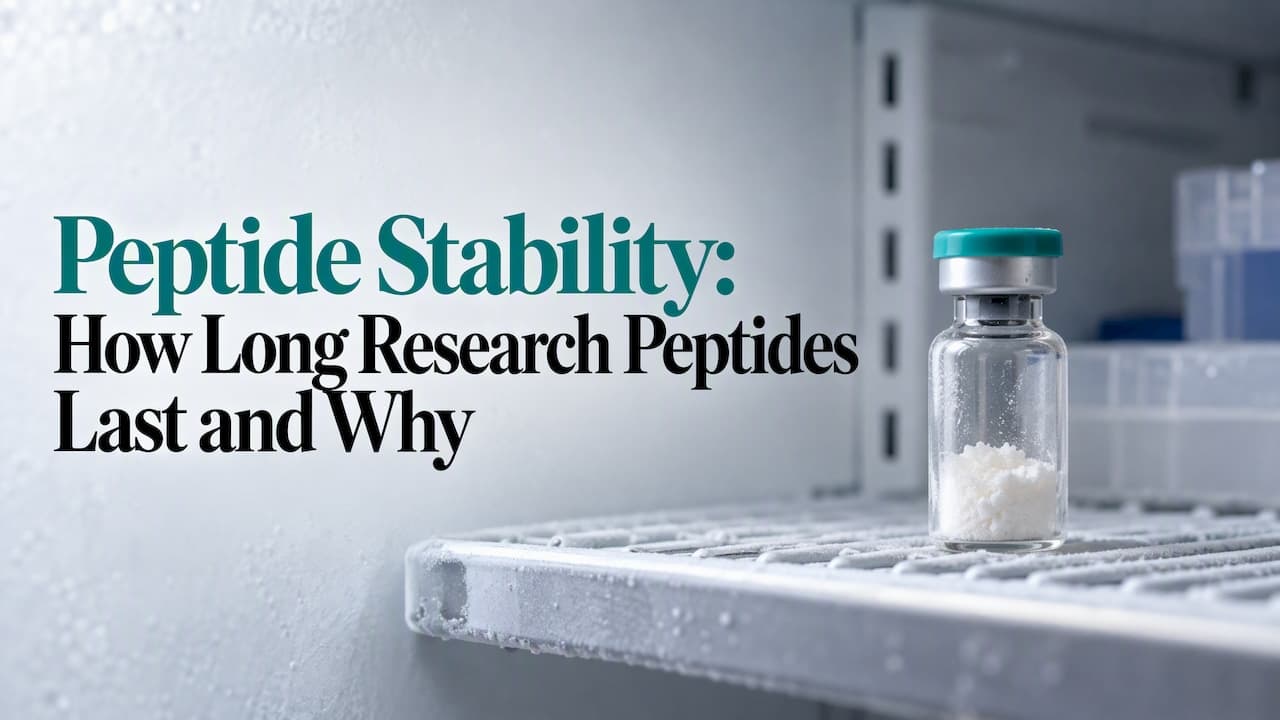
Peptide stability depends on three things: the sequence, the physical state and how the vial is handled. As a lyophilised (freeze-dried) powder kept cold, dry and dark, many peptides stay stable for years. Once dissolved, the same peptide may last days or weeks. There is no single shelf life that fits every sequence, so the useful skill is knowing which routes of degradation your peptide is exposed to and controlling them.
This guide is written for researchers, lab managers and students who buy, store and reconstitute research peptides in the UK. It covers what degrades peptides, how long you can reasonably expect them to last, and how to set up storage that protects your data.
TL;DR
- Lyophilised powder is the most stable form. Storage at -20°C, preferably -80°C, away from light and moisture, can keep many peptides stable for several years.
- In solution, shelf life drops sharply. At 4°C it is typically under a week, and freezing aliquots extends it.
- Stability is sequence-dependent. Cys, Met and Trp oxidise; Asn and Gln deamidate; Asp, Glu, Lys, Arg and His attract moisture.
- Aliquot on day one, use a sterile buffer at pH 5 to 6, avoid repeated freeze-thaw cycles and write down an in-use discard date.
- Check the Certificate of Analysis and the date of manufacture before you judge a vial "off".
Table of Contents
- What peptide stability actually means
- Why lyophilised peptides last longest
- The main degradation routes, by amino acid
- How long do research peptides last? Realistic shelf-life ranges
- Setting up storage that protects your results
- How to tell if a peptide has gone bad
- Why purity at the start affects stability later
- Perspective: what we see in practice
- Sourcing peptides for your research
- A quick stability checklist for your lab
- FAQ
- Sources
What peptide stability actually means
A peptide does not simply expire. Stability is the resistance of a peptide to chemical and physical change during storage and use, and it is shaped by the sequence, the formulation, the excipients and the environment. ScienceDirect's pharmacology overview frames it in exactly these terms.
It helps to separate two kinds of instability:
- Chemical instability: covalent changes to the molecule, such as hydrolysis, oxidation and deamidation. The peptide you weigh out is no longer the peptide on the label.
- Physical instability: the molecule is intact but behaves differently, through aggregation, adsorption to surfaces, precipitation or gelation. A review of aggregation in peptide therapeutics covers the factors involved in depth.
Both matter in the lab. A chemically pure peptide that has aggregated in a vial will give you lower effective concentration and noisy assay results, and you may never see the cause.
Why lyophilised peptides last longest
Water drives most degradation routes. Hydrolysis needs it, deamidation is faster with it, and microbes need it to grow. Freeze-drying removes most of that water and leaves a solid in which molecular movement is limited.
According to the ScienceDirect overview, lyophilised peptides should be stored at -20°C, preferably -80°C, and many remain stable for several years in that form. Lyophilisation is not a guarantee, though. As the MDside review of powder versus reconstituted vials notes, residual moisture, temperature and excipients still influence degradation in the solid state.
Two practical consequences follow:
- Warm the vial to room temperature before opening it. A cold vial opened in a humid lab pulls condensation onto the powder. Let it equilibrate in a desiccator or sealed bag first.
- Reseal quickly. Every minute open to air adds moisture, which matters most for hygroscopic sequences (see below).
The main degradation routes, by amino acid
Stability is residue-specific. Reading your sequence is the quickest way to predict where trouble will come from. The ScienceDirect overview lists the main pathways as hydrolysis, oxidation, deamidation, aggregation and bacterial contamination.
| Residues in the sequence | Main risk | What to do |
|---|---|---|
| Cys (C), Met (M), Trp (W) | Oxidation | Limit exposure to air and light; consider oxygen-free buffers and a headspace of inert gas |
| Asn (N), Gln (Q) | Deamidation | Keep solutions at pH 5 to 6, cold, and short-lived |
| Asp (D), Glu (E), Lys (K), Arg (R), His (H) | Hygroscopic: absorb moisture from air | Equilibrate before opening; store with desiccant; reseal promptly |
| Hydrophobic stretches, high concentration | Aggregation | Work at the lowest practical concentration; avoid agitation |
The residue classes above come from the ScienceDirect topic page. A peptide with several risk residues, for example Met plus Asn, needs more careful handling than one with none.
Oxidation
Cysteine, methionine and tryptophan are the usual victims. Oxidation often shows up as a new, slightly earlier-eluting peak in reverse-phase HPLC, with a mass shift in the mass spectrum. If your peptide contains these residues, minimise air contact, protect it from light and do not leave solutions at room temperature on the bench.
Deamidation
Asparagine and glutamine side chains can lose an amide group. Practitioners cited by MDside note that deamidation half-times can span roughly 2 to 50 years depending on conditions, which is a reminder that the rate depends heavily on pH, temperature and neighbouring residues. A slow route in the freezer can become a real problem in a warm buffer.
Hydrolysis and moisture
Peptide bonds themselves are fairly robust, but acidic or basic conditions and water speed up cleavage, particularly next to certain residues. Moisture uptake by hygroscopic powders can also make a lyophilised cake collapse into a sticky film, which is hard to weigh accurately.
Aggregation and surface effects
Physical stability is often the hardest to manage. According to a 2022 review of strategies for improving peptide stability, aggregation can be triggered by surface contact, agitation and even the type of container, and concentration influences whether amorphous aggregates or structured fibrils form. In practice: choose low-binding, inert vials, avoid vigorous vortexing, and do not assume that a clear solution is a monomeric one.
How long do research peptides last? Realistic shelf-life ranges
People search for a number, so here is the honest version. Use these as planning baselines, then defer to the Certificate of Analysis and any sequence-specific data.
| Form and condition | Typical expectation | Source basis |
|---|---|---|
| Lyophilised, -20°C to -80°C, dry, dark | Several years for many peptides | ScienceDirect overview |
| Solution at 4°C | Typically less than a week | ScienceDirect overview |
| Solution, frozen in single-use aliquots | Longer than at 4°C; depends on the sequence | Peptide Association guidance |
| Reconstituted multi-use vial | Set a documented in-use limit | See below |
Notice what is missing: a universal figure. Experts in analytical development stress that the main misconception is a one-size-fits-all stability profile. Because stability is sequence-dependent, storage advice for one peptide should not be assumed to hold for another of similar length. The literature on proteolytic stability also points out that methods and results are often not comparable, which is why published numbers for "peptide X" rarely transfer cleanly to your own formulation.
When chemistry is not the limit
A peptide can remain chemically intact in solution and still be unfit to use. Practitioners point out that the practical limit in a research lab is often sterility and the in-use period, because microbial growth in a non-sterile aqueous solution can dictate the true safe life. The same source describes a 28-day discard rule borrowed from clinical compounding standards as a conservative baseline when no manufacturer-specific data exist. That is a clinical-derived convention, not a rule for your assay. Treat it as a starting point, and shorten it if your sequence or buffer warrants it.
Setting up storage that protects your results
Before reconstitution
- Log the vial on arrival. Record lot number, receipt date and the condition on arrival.
- Store it cold and dry. Put it at -20°C, or -80°C for long-term holdings, in its sealed container, with desiccant if the freezer is frost-prone.
- Keep it out of light. Amber bags or a closed box are enough.
- Avoid frost-free freezer cycling. Auto-defrost cycles warm the contents repeatedly. A manual-defrost or ultra-low unit is better for long-term stock.
Reconstitution
- Equilibrate the vial to room temperature before opening.
- Use a sterile solvent or buffer. For solutions, a pH of 5 to 6 with sterile buffers is recommended to limit hydrolysis and deamidation.
- Check solubility on a small amount first. Hydrophobic sequences may need a different solvent system, and a PubMed-indexed paper on storage and handling of custom peptides is a useful reference for this stage.
- Mix gently. Swirl or pipette rather than vortexing hard, since agitation can promote aggregation.
After reconstitution
- Aliquot immediately into single-use volumes. Repeated freeze-thaw is one of the most avoidable causes of loss. The Peptide Association guidance calls aliquoting essential for that reason.
- Freeze aliquots rather than leaving them at 4°C. Freezing extends life compared with refrigeration.
- Label with a discard date. A vial with no documented in-use period is the classic lab mistake: even refrigerated or frozen, a reconstituted peptide keeps degrading slowly and can be contaminated.
- Avoid multi-dose vials where you cannot guarantee aseptic technique.
How to tell if a peptide has gone bad
You often cannot tell by eye, which is why "it looks fine" is a weak test. Signs that should make you stop and investigate:
- Powder that has collapsed, turned sticky or changed colour.
- A solution that is cloudy, has particles or has developed a film.
- Reduced activity or shifted dose-response curves compared with a previous lot.
- A new peak, a changed retention time or a lower main-peak area on HPLC, or unexpected masses on LC-MS.
If the result matters, re-test. A quick analytical check against the original Certificate of Analysis tells you far more than visual inspection. Where a series of experiments depends on one stock, consider running a small in-house stability check at the start and end of the series.
Why purity at the start affects stability later
A peptide that begins with residual synthesis by-products, such as deletion sequences, leftover protecting groups or residual salts, starts from a weaker position. Impurities can change moisture uptake and can complicate interpretation of any later degradation. A high-purity starting material gives you a clean baseline: when you later see a new HPLC peak, you know it is a change in storage, not something that was there on day one.

That is why we treat purity data and documentation as part of stability, not a separate topic.
Perspective: what we see in practice
We supply research peptides at 99%+ HPLC purity, and we think about stability as a shared job between supplier and lab. Our part is the starting material: stringent quality controls, verification of each product and a Certificate of Analysis you can check against your own results. Your part begins when the vial is opened.
The most common problems we would flag are not exotic. They are an unlabelled vial, a freeze-thaw habit nobody questioned, and a reconstituted stock kept "just in case" long past a sensible limit. None of these is fixed by a better peptide. All of them are fixed by a documented routine.

Our advice is to write a one-page handling SOP for each peptide in your freezer: where it lives, how it is reconstituted, how it is aliquoted, and when it is discarded. Read the sequence first, because that tells you whether to worry about oxidation, deamidation or moisture. And never carry one peptide's storage assumptions over to the next.
All our products are supplied strictly for laboratory and scientific research. They are not for human or veterinary consumption.
— Neil
Sourcing peptides for your research
If you are restocking or setting up a new project, our catalogue of research peptides is available at BioForgeUK, each with 99%+ HPLC purity, supporting documentation including Certificates of Analysis, and a secure checkout. Our Research Use Only page explains the terms on which we supply.
A quick stability checklist for your lab
- Read the sequence and mark C, M, W, N, Q, D, E, K, R and H residues.
- Store lyophilised stock at -20°C or colder, dry and dark.
- Equilibrate vials before opening and reseal promptly.
- Reconstitute with sterile solvent or buffer, usually at pH 5 to 6 for solutions.
- Aliquot into single-use volumes and freeze them.
- Label every aliquot with the date, concentration and discard date.
- Use inert, low-binding containers where aggregation is a concern.
- Re-test against the Certificate of Analysis when a result looks off.
FAQ
How long do lyophilised peptides last?
When stored at -20°C or colder, dry and away from light, many lyophilised peptides remain stable for several years, according to pharmacology reference guidance. The exact figure depends on the sequence, so check the Certificate of Analysis and any supplier data for your specific peptide.
How long is a peptide good for after reconstitution?
In solution at 4°C, shelf life is typically under a week. Freezing single-use aliquots extends it, but by how much depends on the sequence. Set and document a discard date for every reconstituted stock rather than relying on appearance.
Why should I avoid repeated freeze-thaw cycles?
Each cycle can promote aggregation and chemical degradation, and it exposes the solution to temperature swings and condensation. Dividing the stock into single-use aliquots means you thaw only what you need, once.
Where should lyophilised peptides be stored?
In a freezer at -20°C, or -80°C for long-term holdings, in a sealed container, protected from light and moisture. Let the vial reach room temperature before opening it so that condensation does not form on the powder.
Sources
- Peptide Stability, ScienceDirect Topics
- Peptide Reconstitution & Storage, Peptide Association
- Peptide stability: from lyophilized powder to reconstituted vial, MDside
- Strategies for Improving Peptide Stability and Delivery, PMC
- Factors affecting the physical stability (aggregation) of peptide therapeutics, PMC
- The Challenge of Peptide Proteolytic Stability Studies, Angewandte Chemie
- Storage and handling guidelines for custom peptides, PubMed