
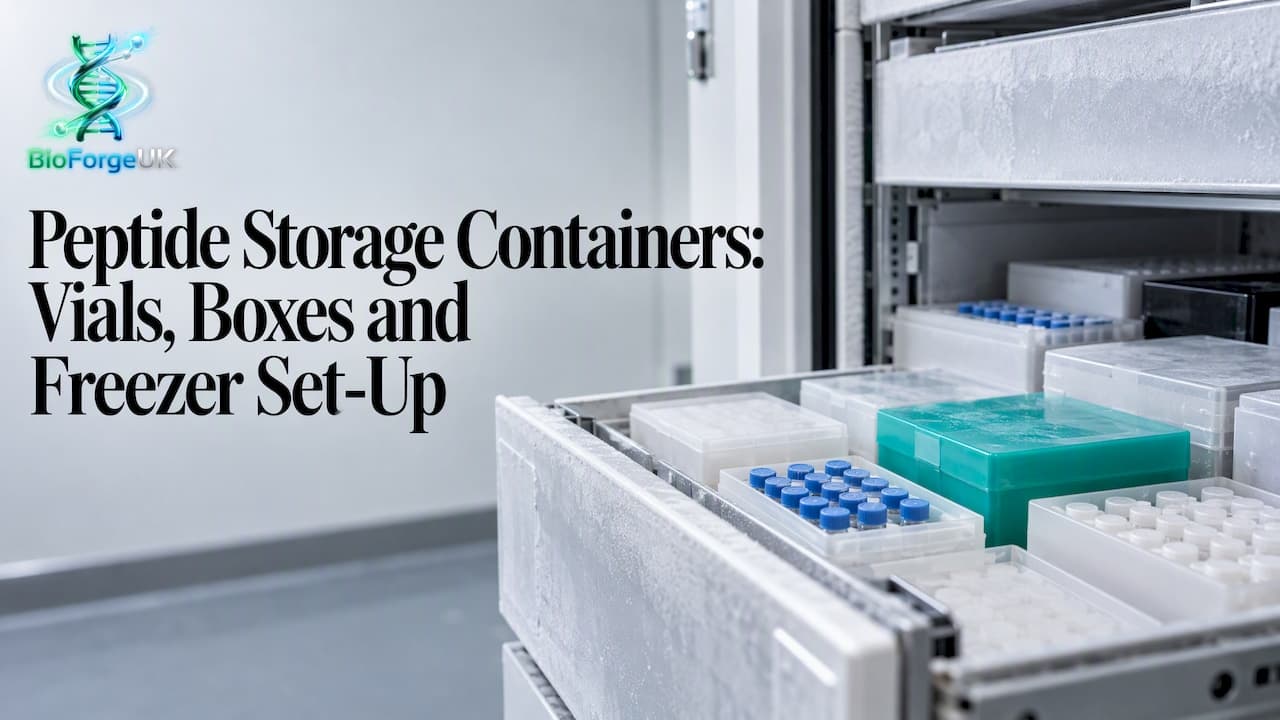
The best container for a lyophilised research peptide is a chemically inert, tightly sealed vial (polypropylene or glass, amber if the sequence is light-sensitive). Keep it inside a dry, opaque secondary box in a cold, stable freezer. The box organises your stock. The vial and the cold do the preserving.
Most search results for this topic show organiser cases with foam or 3D-printed inserts. Those are useful, but they are only half the answer. This guide separates the primary container (the vial that touches the peptide) from the secondary container (the box, the freezer, the desiccant), and explains what each one has to do in a UK research lab.
Everything here concerns laboratory research materials. Our products are supplied strictly for laboratory and scientific research, not for human or veterinary consumption.
TL;DR
- Treat the vial as the real storage container. Use polypropylene or glass, and choose amber or shielded storage when a sequence is light-sensitive.
- For long-term storage of dry peptide, the NIBSC guidance points to -20°C or colder, in the dark and dry. Room temperature is fine only for days to weeks, such as transit.
- 3D-printed cases and travel boxes are for organisation. They are not sterile primary containers.
- Add desiccant to the secondary box, not into the vial, and let a vial reach room temperature before opening it.
- A temperature rating is not a shelf life. Stability depends on the sequence.
Table of Contents
- Primary and secondary containers: what each one does
- Choosing a vial material
- Temperature: which cold, and for how long
- Desiccant: where it goes and what it does
- Inert gas for repeatedly opened vials
- Organiser cases and 3D-printed boxes: when they help
- Perspective: what we see from the supply side
- A simple set-up for a UK research lab
- Peptides for research, from a supplier that documents them
- Common storage mistakes to avoid
- FAQ
- Sources
Primary and secondary containers: what each one does
Peptide storage fails in four ways: moisture, light, oxygen and temperature swings. Different containers solve different problems.
| Layer | Examples | Job |
|---|---|---|
| Primary container | Polypropylene vial, glass vial, amber glass vial, sealed cap or septum | Holds the peptide, stays chemically inert, keeps air and moisture out |
| Secondary container | Opaque box, vial rack, insert case, zip bag | Blocks light, keeps vials upright and labelled, carries the desiccant |
| Environment | Fridge, -20°C freezer, -80°C freezer | Slows chemical degradation |
A case marketed as a peptide storage container, with 3, 5 or 10 ml vial slots, belongs in the second row. The NIBSC peptide library notes make the same distinction in effect: they describe cold, dry and dark conditions rather than any particular box. Commercial 3D-printed organisers are not designed or validated as sterile primary containers, so do not rely on one to protect an exposed or loosely capped vial.
Choosing a vial material
Polypropylene
Polypropylene is the common choice for good reasons: it is durable, it does not shatter in a -80°C freezer, and it is generally chemically inert. The trade-offs are that it is translucent and not resistant to every solvent. If you will store a peptide dissolved in an organic solvent, check compatibility before you commit.
Glass and silanised glass
Glass gives you visibility and wider solvent tolerance. A mass spectrometry handling review in PMC notes that peptides in solution can adsorb non-specifically to both plastic and glass walls, especially at high dilution, and that this can cause real loss of material and distorted results. Silanised glass is one way to reduce that. For dry lyophilised powder the effect matters less. For dilute stock solutions used in quantitative work, it matters a great deal.
Amber or clear?
The same review advises keeping vials away from light, and for sensitive sequences amber or dark containers are the safer choice. If your vials are clear, put them in an opaque box or a drawer rather than leaving them on an open shelf. Tryptophan-containing sequences are a typical example of residues worth protecting, but check the sequence you actually hold rather than assuming.
Closures
Whatever the material, the closure decides how much moisture gets in. Use caps with intact liners or septa, and replace any that are cracked or deformed after repeated piercing or freeze cycles. A good vial with a poor cap is a poor container.
Temperature: which cold, and for how long
The NIBSC guidance is clear on the principle. Peptides belong in a dry, cool, dark place. For best preservation, store at 4°C or colder away from bright light. Dry peptides are stable at room temperature for days to weeks, and for long-term storage you move to -20°C or lower. You can read the detail on the NIBSC peptide storage page.
In practice:
- On arrival: check the vial is sealed and undamaged, then move it into the fridge or freezer promptly.
- Short term (weeks): a fridge at 2 to 8°C, sealed, dark and dry, is generally acceptable for lyophilised material.
- Long term (months or more): -20°C or colder. Many labs use -80°C for valuable or sensitive stock.
- After reconstitution: stability drops sharply and depends on the sequence and the solvent. Our reconstitution guide covers the handling side, and our lyophilised peptide storage guide goes deeper on temperatures.
A temperature is not a shelf life
The most common mistake we see is treating "stored at -20°C" as a promise of potency. It is a condition for preservation. How long a given peptide lasts is sequence-dependent: peptides rich in cysteine, methionine or tryptophan oxidise more readily, and sequences with asparagine or glutamine can be more prone to other degradation routes. Our article on how long research peptides last explains the reasoning.
Freezer choice
For peptide freezer storage, the type of freezer matters as much as the setpoint. Frost-free models run periodic warming cycles to clear ice, and those cycles can expose vials to repeated small temperature swings and moisture. For long-term stock, a manual-defrost or purpose-built laboratory freezer is the better choice, ideally with a calibrated thermometer or a logger. Keep peptide stock in a stable inner part of the freezer rather than the door, and avoid storing it where it will be moved constantly.

Desiccant: where it goes and what it does
Desiccant is one of the most-searched add-ons, and it is often misused. The point is to keep the secondary container dry, because lyophilised peptide is hygroscopic and any moisture that reaches it speeds degradation.
- Put it in the box, not the vial. Place a sachet of silica gel or reusable indicator beads in the secondary container that holds the vials, separated from the vials so beads never touch a cap.
- Use an indicating type. Colour-change beads show when they are saturated, so you know when to replace or regenerate them according to the manufacturer's instructions.
- Seal the box. Desiccant in a box that does not close properly achieves very little.
- Let vials warm up before opening. Taking a cold vial straight into humid air makes condensation form on the powder. Allow it to reach room temperature in its closed box first, then open it.
Desiccant does not replace a good cap, and it does not make room-temperature storage safe for the long term.
Inert gas for repeatedly opened vials
If a vial will be opened more than once, closing it is not enough to stop oxidation of residues such as cysteine, methionine or tryptophan. The NIBSC notes describe displacing the air in the vial with dry inert gas, nitrogen or argon, before resealing and returning it to cold storage. This is most worthwhile for sensitive sequences. A simpler approach for many labs is to aliquot a peptide at the start, so that each vial is opened once.
Organiser cases and 3D-printed boxes: when they help
The cases that dominate search results (insert boxes for 3 ml, 5 ml or 10 ml vials, latching organisers, 56-vial racks) solve a genuine problem: loose vials get lost, mislabelled and knocked over. A good organiser is worth having if it:
- is made of a material rated for your storage temperature, so it does not crack at -20°C or -80°C;
- holds vials upright, with space for a label you can read;
- closes firmly and is opaque, or can sit in an opaque outer bag;
- is easy to wipe down, since 3D-printed surfaces can be porous and difficult to clean thoroughly;
- has room for a desiccant sachet.
What it cannot do is turn a poor vial into a good one. Treat any hobby-grade case as storage furniture. If you work under a quality system, a printed insert is usually not something you can validate, so keep vials in their original sealed packaging or a racking system approved by your lab.
Perspective: what we see from the supply side
We supply research peptides to laboratories, and the storage questions we hear are rarely about the box. They are about confidence: is the material I am about to use the same as the material I received?

Our view is that storage is the second half of a quality chain that begins with purity. We supply peptides at 99%+ HPLC purity, with a Certificate of Analysis, because there is no point storing something carefully if you cannot verify what it was on day one. The certificate of analysis guide shows how to read the result, and our piece on HPLC versus UPLC explains how purity is measured.
Practically, we recommend three habits. Record the date of receipt and every opening on the vial or in a log. Keep a single working aliquot out of the freezer at a time, so the stock vial is not cycled. And when results drift, check storage history before blaming the assay.
— Neil
A simple set-up for a UK research lab
Here is a configuration that covers most small-lab needs without specialist kit.
- Receive and inspect: confirm the cap seal, label and batch number against the Certificate of Analysis.
- Log it: note the date, batch and storage location.
- Choose the container: keep the original vial if it is polypropylene or amber glass and the seal is intact. If you transfer or aliquot, use a clean, inert vial with a secure closure.
- Add the secondary box: an opaque, lidded box with a desiccant sachet, labelled with contents.
- Pick the temperature: fridge for the short term, -20°C or colder for the long term, in a manual-defrost or laboratory freezer.
- Open carefully: bring the sealed box to room temperature, open, take what you need, purge with inert gas if the sequence is sensitive, reseal and return it.
- Review: check desiccant colour, freezer temperature records and vial condition at regular intervals.
Travel and transit
Short periods outside the cold chain are normal in logistics. The NIBSC guidance says dry peptides tolerate room temperature for days to weeks, so a delayed courier delivery of lyophilised material is not automatically a problem. Once the vial has arrived, though, do not leave it on a bench. Move it to cold storage the same day.
Peptides for research, from a supplier that documents them
If you are setting up storage for new stock, start with material that arrives documented. BioForgeUK supplies research peptides at 99%+ HPLC purity with Certificates of Analysis and a secure checkout, all strictly for laboratory and scientific research use. You can read how we handle the research use only designation before you order, or browse from our main site. For the regulatory background, see our article on what research use only means in the UK.
Common storage mistakes to avoid
- Repeated freeze-thaw cycles of one stock vial. Aliquot instead.
- Opening cold vials in humid air, which causes condensation.
- Storing clear vials in the light, on a bench or in a kitchen-style fridge door.
- Relying on a frost-free freezer for months-long storage.
- Treating a case as sterile protection. An organiser is not a primary container.
- Ignoring the sequence. Residues such as cysteine, methionine and tryptophan need extra care.
- Assuming temperature equals shelf life. Check the stability evidence for the specific peptide, including endotoxin and purity data where relevant. Our endotoxin testing guide covers one such check.
FAQ
What is the best container for storing lyophilised peptides?
A sealed, chemically inert vial, usually polypropylene or glass, with amber or light-shielded storage for sensitive sequences. Put it inside an opaque secondary box with desiccant, and keep that in the cold. The box organises the vials, but the vial itself is the primary container.
What temperature should I store peptides at?
For lyophilised peptide, the NIBSC guidance recommends 4°C or colder for good preservation, and -20°C or lower for long-term storage, in a dry, dark place. Room temperature is acceptable for days to weeks, such as during transit. Peptides in solution are far less stable and depend on the sequence.
Should I put desiccant in my peptide storage box?
Yes, in the secondary box and kept apart from the vial caps. An indicating desiccant tells you when it is spent. It does not replace a good seal, and you should still let the sealed box warm to room temperature before opening a vial.
Is a frost-free freezer suitable for peptides?
It is not ideal for long-term storage, because the defrost cycles cause small temperature swings that can add moisture and thermal stress. A manual-defrost or laboratory freezer with a stable setpoint is the better option for stock you intend to keep for months.
Are 3D-printed vial cases safe for peptides?
They are fine as organisers for sealed vials, provided the material tolerates your storage temperature and the case closes and can be cleaned. They are not sterile primary containers, so never use one in place of a properly closed vial.
Sources
- NIBSC: Peptide storage (peptide library)
- NIBSC: Storage of peptides
- Recommendations for the generation, quantification, storage and handling of peptides used for mass spectrometry-based assays (PMC)