
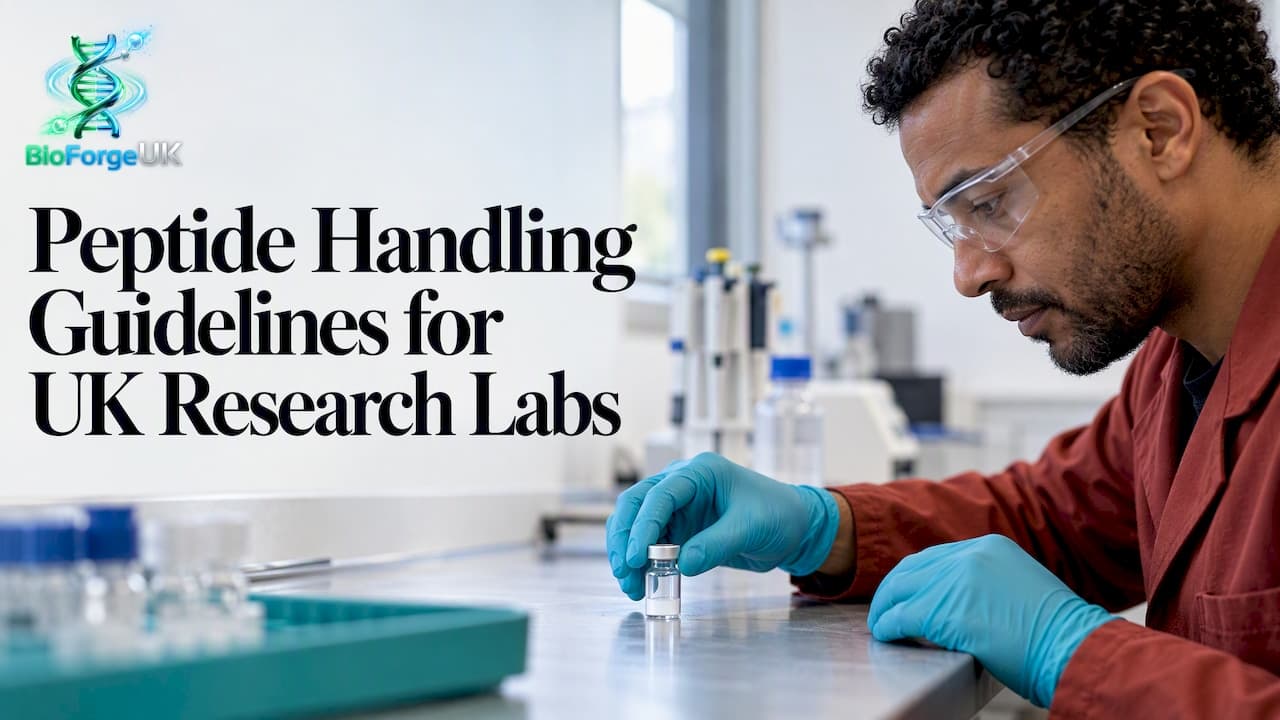
Good peptide handling comes down to four habits: keep the material cold, dry and dark; let the vial reach room temperature before you open it; touch the powder as little as possible; and freeze dissolved peptide in single-use aliquots. Get those right and most stability problems never start. This guide walks through each stage, from the moment a vial arrives to the moment its waste leaves the bench, with the reasoning behind each step so you can adapt it to your own sequence and assay.
Everything here applies to peptides supplied for laboratory research only. It is not guidance on use in people or animals.
TL;DR
- Store lyophilised peptide in a dry, cool, dark place, and at -20°C or colder for the long term. Warm the sealed vial to room temperature before opening it.
- Dissolve in sterile distilled water or dilute acetic acid first. Move to sequence-based solvent choices only if that fails, and check the solvent against your assay.
- Freeze solutions as single-use aliquots at -20°C or colder, in a freezer that does not run automatic defrost cycles.
- Moisture is the main enemy of dry peptide. Every unnecessary opening of the vial costs stability.
- Risk-assess the work under COSHH, wear gloves and a lab coat, and dispose of waste under the applicable regulations.
Table of Contents
- Why handling matters as much as purity
- On arrival: check, log and store
- Storing lyophilised peptide
- Opening the vial: the warm-up step
- Weighing lyophilised peptide
- Dissolving peptides: a sensible order of attempts
- Storing peptide in solution
- How long can peptides stay unrefrigerated?
- Contamination: what to control
- Laboratory safety and waste
- Our perspective
- Sourcing material that is easier to handle well
- Quick reference
- FAQ
- Sources
Why handling matters as much as purity
A peptide that left the synthesis lab at 99% purity can be a different material by the time it reaches your assay. Aggregation, oxidation, hydrolysis and adsorption to surfaces all shorten useful life, and a review of factors affecting the physical stability of peptides lists sequence, concentration, pH, net charge, excipients, chemical degradation, surfaces and impurities among the influences on aggregation.
The practical consequence is quantitative. Researchers working with mass spectrometry assays have pointed out that these methods are so sensitive that rigorous storage and handling protocols are needed to keep concentrations accurate and to avoid artefacts from degradation or adsorption. If your result depends on a precise concentration, your handling is part of your method.
For a deeper look at how long different materials last, see our guide to peptide stability.
On arrival: check, log and store
The first ten minutes after delivery set the tone for the life of the vial.
- Inspect the packaging. Look for damaged seals, cracked vials or signs of moisture inside the outer packaging. Photograph anything unusual before you open further and contact the supplier promptly.
- Match the paperwork. Check the vial label, batch number and quantity against your order and the Certificate of Analysis. If you want to know what each line on that document means, our guide on how to read a peptide Certificate of Analysis explains purity, identity and the other entries.
- Log the material. Record date received, batch, storage location and who opened it. A simple log makes later troubleshooting far easier.
- Move it to storage quickly. Do not leave sealed vials on a bench in sunlight or near a heat source while you finish other tasks.
If you are unsure about the research-only status of what you have ordered, our page on research use only peptides in the UK explains what the label means.
Storing lyophilised peptide
Freeze-dried powder is the most stable form a peptide takes, so keep it that way for as long as you can.
The NIBSC guidance on peptide storage recommends a dry, cool, dark place, with -20°C preferred for long-term storage. Several commercial handling sheets echo this and add that a standard refrigerator at around 4°C is acceptable for the short term. For stock you will not touch for months, go colder.
For storage beyond about six months, the recommendations published by Hoofnagle and colleagues advise keeping dry powder under argon or nitrogen, or in a desiccator, at -20°C or lower. That matters most for sequences that are sensitive to oxidation or that readily pick up water.
Practical storage rules
- Keep vials tightly closed, in a secondary container with desiccant if your freezer is humid.
- Store away from bright light. An opaque box is enough.
- Avoid placing vials in the freezer door, where temperature swings are largest.
- Label the secondary container as well as the vial, so you do not open boxes unnecessarily to find something.
Our practical guide to lyophilised peptide storage goes further on freezer set-up and inventory habits.
Opening the vial: the warm-up step
This is the step most often skipped, and the one that does the most avoidable damage. A cold vial opened in a warm lab acts like a cold glass of water on a summer day: moisture from the air condenses on the powder. NIBSC notes that moisture contamination greatly decreases long-term stability of dry peptides.
A reliable routine:
- Take the vial from the freezer and place it, still sealed, in a desiccator or a closed box on the bench.
- Wait until it reaches room temperature. For a small vial this is usually a matter of tens of minutes, but judge by touch and by the absence of any condensation on the glass.
- Wipe the outside dry, put on clean gloves, and open it.
- Weigh out what you need quickly, then reseal. If you can, flush the headspace with dry nitrogen or argon before closing.
- Return the vial to the freezer without delay.
Gloves are not only for your protection. They keep skin oils, enzymes and microbes off the peptide and off the weighing tools.
Weighing lyophilised peptide
Freeze-dried powder is light, fluffy and often statically charged. It can jump from a spatula and it is hygroscopic, so it gains weight as it sits on the balance.
- Spin the vial briefly in a centrifuge before opening, so powder is not lodged under the cap.
- Use an anti-static device or a metal spatula if static is a problem.
- Weigh in a draught-free enclosure, and work fast.
- Weigh only what you need. Repeated small withdrawals from the same vial mean repeated exposure to humid air.
- Remember that the gross weight is not the peptide content. Counter-ions and residual water mean a vial's net peptide content is lower than its total mass. Your Certificate of Analysis and supplier documentation should help you correct for this when exact molarity matters.
If you need an accurate concentration for quantitative work, consider dissolving the whole vial in a known volume rather than weighing out portions.
Dissolving peptides: a sensible order of attempts
There is no universal solvent. Solubility depends on sequence, length and charge, so the safest approach is a short, stepwise test on a small portion before you commit the whole vial.
Step 1: water or dilute acid
NIBSC advises starting with sterile distilled water or sterile 0.1% acetic acid to make a concentrated stock, then diluting with a suitable buffer. The same page notes that sterile buffers at around pH 5 to 6 can prolong the storage life of solutions.
Step 2: read the sequence
If water or acid fails, look at the amino acid composition. The same guidance suggests that charge-based or hydrophobicity-based approaches may then be needed, using solvents such as DMF, DMSO or chaotropic salts. As a general principle:
- Peptides rich in basic residues (lysine, arginine, histidine) tend to dissolve better in slightly acidic solutions.
- Peptides rich in acidic residues (aspartate, glutamate) tend to dissolve better in slightly basic solutions.
- Strongly hydrophobic sequences may need a small volume of organic solvent first, followed by slow, dropwise dilution into aqueous buffer.
Step 3: check the solvent against your assay
The step people forget. Whatever you use must be compatible with the system downstream. A solvent that dissolves your peptide perfectly may inhibit an enzyme, stress cells or interfere with detection. Decide your acceptable final solvent concentration before you dissolve anything, and work backwards.
Add the solvent slowly, mix gently by swirling or brief vortexing, and avoid prolonged sonication, which warms the sample. A fully dissolved peptide gives a clear solution. If it stays cloudy, do not assume it will clear on its own: that is often aggregation.
For a full walk-through with worked volumes, see our laboratory guide to peptide reconstitution.
Storing peptide in solution
Peptides are far less stable once dissolved. Hydrolysis, oxidation, deamidation and microbial growth all become real concerns, and sequences containing cysteine, methionine or tryptophan are especially vulnerable to oxidation.
The key rules:
- Aliquot immediately. Divide the stock into single-use portions so each is thawed once. Hoofnagle and colleagues recommend -20°C or colder in single-use aliquots to avoid repeated freeze-thaw cycles, which harm stability.
- Skip the frost-free freezer. NIBSC specifically warns against frost-free freezers because their automatic defrost cycles cause temperature fluctuations.
- Use sterile tubes and solvents. Low-binding tubes can reduce adsorption losses for sticky, hydrophobic peptides at low concentration.
- Label clearly. Peptide name, batch, concentration, solvent, date and your initials.
- Do not refreeze leftovers. Discard what you do not use, or accept the loss of integrity and treat the result accordingly.
Some suppliers publish tables of expected stability windows for solutions. Treat those as starting points, then validate against your own sequence with an analytical check if the experiment is critical.
How long can peptides stay unrefrigerated?
It is one of the most common questions, and the honest answer is: it depends on the form and the sequence.
For dry powder, the picture is reassuring. NIBSC states that lyophilised peptides are stable at room temperature for days to weeks, which is why shipping without cold packs is generally workable, though moisture contamination greatly reduces long-term stability. A vial that sat on a courier's van for a few days is rarely a problem, provided it was sealed and dry.
For dissolved peptide, the margin is far smaller. Nothing in the evidence we reviewed supports leaving a solution at room temperature for extended periods, and the factors behind aggregation and chemical degradation, including concentration, pH and impurities, work faster in solution. If a solution has sat out, ask whether the assay can tolerate a degraded sample. If it cannot, make fresh.

Specific named peptides vary, and we do not offer a universal number of hours. If a vial has been out of its recommended conditions, check the supplier's documentation for that sequence and consider confirming integrity by HPLC or mass spectrometry before relying on the data. For background on why HPLC is the standard purity check, see HPLC vs UPLC.
Contamination: what to control
| Risk | Typical source | Control |
|---|---|---|
| Moisture | Opening a cold vial; humid lab air | Warm to room temperature sealed; reseal fast; desiccant |
| Oxidation | Air in the headspace; sensitive residues | Inert gas flush; minimal opening; cold storage |
| Microbial growth | Non-sterile water, tubes or pipette tips | Sterile solvents and consumables; aliquot; freeze |
| Cross-contamination | Shared spatulas, reused tips | Clean tools per peptide; fresh tips every time |
| Adsorption | Plastic or glass surfaces at low concentration | Low-binding tubes; avoid very dilute long-term storage |
| Endotoxin | Raw material or water source | Endotoxin-tested material and water for cell work |
For cell-based or in vivo-adjacent research models, endotoxin deserves its own check. Our article on peptide endotoxin testing explains what to look for.
Laboratory safety and waste
Most research peptides in routine use are not acutely hazardous, but "not obviously dangerous" is not a risk assessment. In the UK, work with chemicals and biological agents falls under COSHH, and the sensible starting point is a written assessment of the specific peptide, the solvents (DMF, for example, is a hazardous solvent in its own right) and the quantities involved.
Basic precautions
- Wear gloves, a lab coat and eye protection. Change gloves when they are contaminated.
- Handle powder in a way that avoids creating dust, ideally in a ventilated enclosure or cabinet for fine, potent or poorly characterised material.
- Read the safety data sheet for the peptide and each solvent before you start.
- Keep food, drink and personal items out of the work area.
Special cases
Some peptide work sits in a much higher hazard category. For prions and proteopathic seeds, the UK guidance on laboratory containment and control measures says COSHH requires the containment level to match the hazard group of the agent, with risk assessment determining the controls. It also calls for appropriate protective clothing, waterproof dressings over cuts and abrasions, and a clean work area. If your research touches such materials, speak to your institution's biological safety officer before you handle anything.
Waste
Treat peptide waste, contaminated tips, empty vials and solvent mixtures as laboratory waste, segregated according to your institution's procedures. Where research materials fall under a Defra authorisation, the department's guidance states that the materials and waste derived from them must be disposed of under the applicable waste regulations. Solvent waste in particular should never go down the sink.
Our perspective
We supply research peptides, so we see what happens between a clean Certificate of Analysis and a usable result. Our view is that purity and handling are two halves of the same job. We test to 99%+ HPLC purity and document it, but that figure describes the vial on the day it was tested. It is your handling that decides whether the same material is still at that standard when it reaches your assay.

The habits we would insist on in any lab are unglamorous: warm the vial before opening, open it as rarely as possible, aliquot solutions the first time, and write everything down. Most of the failed experiments we hear about trace back to a moisture event or a freeze-thaw cycle, not to the peptide itself.
We also want to be plain about the boundaries. Our products are supplied strictly for laboratory and scientific research, not for human or veterinary consumption, and we do not give guidance on administering them. If a question is about use outside the lab, it is not one we can or should answer.
— Neil
Sourcing material that is easier to handle well
Good handling starts with good documentation. BioForgeUK supplies research peptides at 99%+ HPLC purity, with Certificates of Analysis and a secure checkout, for laboratories and research institutions. You can read how we define research-only supply on our research use only page, or visit the BioForgeUK homepage to see the range.
Quick reference
| Stage | Do | Avoid |
|---|---|---|
| Receipt | Inspect, match batch to CoA, log it | Leaving vials in warm or bright spots |
| Long-term storage | Dry, dark, -20°C or colder; inert gas or desiccator for 6+ months | Frost-free freezers; the freezer door |
| Opening | Warm sealed vial to room temperature first | Opening a cold vial in humid air |
| Weighing | Quick, anti-static, only what you need | Repeated dips into the same vial |
| Dissolving | Water or 0.1% acetic acid first; then sequence-based choices | Skipping the assay-compatibility check |
| Solutions | Single-use aliquots at -20°C or colder | Refreezing leftovers |
| Disposal | Segregate; follow COSHH and waste rules | Pouring solvents down the drain |
FAQ
How long do unrefrigerated peptides last?
Dry, sealed lyophilised peptides are generally stable at room temperature for days to weeks, which is why they can be shipped without refrigeration. Dissolved peptides are much less tolerant and should be kept frozen as aliquots. Because sequences differ, check the documentation for your specific peptide and confirm integrity analytically if the work is critical.
What should you not mix with peptides?
Avoid any solvent, buffer or additive you have not checked against both the peptide and your assay. Hydrophobic peptides can precipitate if you add aqueous buffer too quickly, and strong bases or oxidising agents can degrade sensitive residues. Always test solubility on a small portion first.
Do I need to warm a peptide vial before opening it?
Yes. Opening a cold vial lets condensation form on the powder, and moisture is the biggest threat to dry peptide stability. Leave the sealed vial at room temperature until it has fully warmed and there is no condensation on the glass.
Can I use a frost-free freezer for peptide solutions?
It is best not to. Automatic defrost cycles cause temperature fluctuations, which stress the peptide and effectively add freeze-thaw cycles. A manual-defrost or laboratory freezer at -20°C or colder is the safer choice.
How are research peptides administered?
They are not. BioForgeUK peptides are supplied strictly for laboratory and scientific research, not for human or veterinary use, and we provide no administration guidance.
Sources
- NIBSC: Peptide Storage
- Recommendations for the generation, quantification, storage and handling of peptides (Hoofnagle et al., 2016)
- Factors affecting the physical stability (aggregation) of peptide therapeutics (2017)
- Laboratory containment and control measures (updated November 2021)
- Defra authorisation guidance IMP-GEN-2024-03