
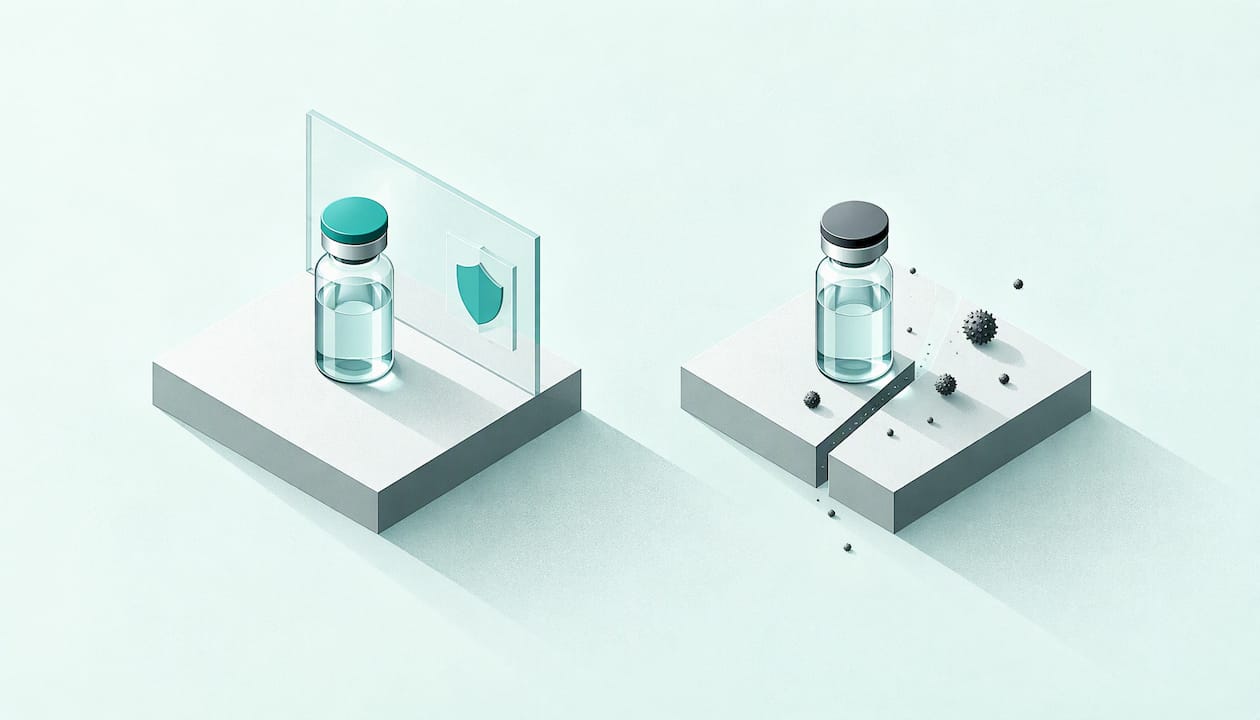
A sterile research peptide has been made and finished by a validated process that controls microbial contamination. A non-sterile one has not, so its microbial status is simply not controlled or verified. Neither word says anything about purity, identity or quantity. Those are separate claims, tested separately, and a lab that mixes them up can build an experiment on an assumption nobody checked. At BioForgeUK we supply research peptides at 99%+ HPLC purity with a Certificate of Analysis, strictly for laboratory use. This guide shows what each term means, what a certificate can and cannot tell you, and how to handle vials so the question matters less.
TL;DR
- Sterile means a controlled process was used to remove or exclude viable microorganisms. Non-sterile means no such process was applied or verified. It does not mean dirty or degraded.
- Regulators treat sterility as something you assure through a validated manufacturing process, not something you prove by testing the finished vial alone.
- HPLC purity, sterility and endotoxin level are three different measurements. A 99% pure peptide has not thereby been shown to be sterile.
- "Sterile water" describes the diluent as supplied. It does not make the reconstituted peptide sterile.
- Good storage and aseptic handling protect any peptide, sterile or not, from the moment the vial is opened.
Table of Contents
- What "sterile" and "non-sterile" actually mean
- Three claims that are often confused
- Does your experiment need sterile peptide?
- Sterile water, bacteriostatic water and the peptide itself
- How to read batch documentation
- Handling: keeping a peptide as clean as it arrives
- A worked example
- What we do
- FAQ
- Sources
What "sterile" and "non-sterile" actually mean
Sterility is a yes-or-no statement about viable microorganisms: bacteria, fungi and their spores. The European Medicines Agency's sterilisation guideline calls sterility a critical quality attribute of sterile substances, products and containers. It also says sterility cannot be assured by testing alone. It has to be built in through a suitably designed, validated and controlled process: bioburden control (the number of microorganisms present before sterilisation), the sterilisation step itself, container closure integrity and aseptic technique.
That last point reshapes how you should read the word. "Sterile" on a label is a claim about a whole chain: the bulk solution, the filtration or sterilisation step, the filling environment and the seal. A single test at the end cannot stand in for that chain.
"Non-sterile" is the plain opposite. No sterilisation process was applied, or none was verified. The material can be perfectly clean and chemically excellent. What you lack is a guarantee about its microbial state.
How sterile material is usually made
The EMA guideline sets out a clear order of preference. Terminal sterilisation, where the finished product in its final container is sterilised, is preferred because it is lethal to micro-organisms and a sterility assurance level can be calculated, validated and controlled with a safety margin. For highly sensitive products, such as most biological products, terminal sterilisation is not possible. There, sterile filtration and aseptic processing under validated and controlled conditions can be accepted.
Peptides are heat-sensitive, so filtration and aseptic filling are the usual route. In practice that means passing the dissolved peptide through a fine membrane (commonly 0.22 micron) before filling into sealed containers in a controlled environment.

Why freeze-drying is not sterilisation
Most research peptides arrive as a lyophilised powder, which means freeze-dried: water is removed from a frozen solution under vacuum. Dry powder is a poor place for microbes to grow, but low moisture is not the same as sterility. Freeze-drying removes water. It does not kill anything, so if a solution carries microbial contamination before it goes into the freeze-dryer, the dry cake carries it too. Sterility depends on what happened before and after drying, not on the drying itself. If you want to understand what else goes into a lyophilised cake, our note on lyophilisation excipients for peptides explains it.
Three claims that are often confused
Labs get into trouble when one good number is read as three. A certificate can report purity and say nothing on sterility or endotoxin.
| Claim | Question it answers | Typical test | Does it tell you about sterility? |
|---|---|---|---|
| Purity | What fraction of the sample's chromatographic signal is the target peptide? | HPLC (UV peak area) | No |
| Identity | Is the molecule the right one? | Mass spectrometry | No |
| Sterility | Are viable microorganisms absent? | Microbiological culture test | Yes, within the limits of sampling |
| Endotoxin | How much bacterial endotoxin is present? | Bacterial endotoxins test | No |
Purity is a chemical statement
HPLC separates a sample into components and reports the share of the signal that belongs to the main peak. That is a relative statement about chemical composition. It is not a measure of how many milligrams are in the vial, it does not identify the molecule, and it does not detect living organisms. Our guide to reading an HPLC peptide purity figure walks through what the number does and does not cover.
Sterility and endotoxin are different again
A sterility test looks for living organisms. Endotoxins are fragments of the outer membrane of Gram-negative bacteria, and they can remain after the bacteria are dead or removed. A material can pass a sterility test and still carry endotoxin. Pharmacopoeias describe the bacterial endotoxins test as an in vitro assay accepted by the major regulators, and it is a separate procedure from the sterility test. If your work involves cells, endotoxin can matter even when sterility is not in question: see what researchers should check on peptide endotoxin testing.
Why a sterility result is a sample, not a guarantee
Sterility testing is destructive. A lab cannot test every vial and still have a batch left, so it tests a sample and extends the result to the lot. That works when processing was uniform. It is the reason the EMA stresses process assurance over end-point testing. When you read a sterility result, ask which material it was run on and whether it plausibly applies to the vial on your bench. That is also the right test for any batch documentation: a result belongs first to the material that was tested, and applies to your vial only if the batch identity matches.
Does your experiment need sterile peptide?
Not every experiment does. The answer depends on what the peptide will touch.
Often worth requiring sterile material:
- Cell culture work, where a contaminant can outgrow your cells or alter the response.
- Long incubations, where a few organisms have time to multiply.
- Any protocol that reuses a stock solution over days or weeks.
- Work with sensitive primary cells or sensitive readouts such as inflammatory markers.
Often fine with non-sterile material, filtered by you if needed:
- Analytical work such as HPLC or mass spectrometry method development, where the sample is injected into an instrument.
- Reference standards and calibration use. See HPLC calibration peptides for how standards are chosen and checked.
- Binding or biochemical assays run in short, controlled conditions.
- Stock solutions you will pass through a 0.22 micron filter into sterile tubes before use.
A practical rule: decide from the protocol, not from habit. If a contaminant would change your result, build a sterile step into your workflow and do not rely on a label alone, whatever the supplier states.
Sterile water, bacteriostatic water and the peptide itself
A frequent point of confusion is the diluent. The two products readers meet most often are sterile water and bacteriostatic water.
Bacteriostatic Water for Injection, USP is described in its prescribing label as a sterile, nonpyrogenic preparation of water for injection containing 0.9% or 1.1% benzyl alcohol as a bacteriostatic preservative, supplied in multi-dose vials. Sterile water has no preservative, so once the container is opened it has nothing to hold back growth. That is why single-use handling is the logic for plain sterile water, and why a preservative is used when a vial will be entered repeatedly.
The key point for this article is that either product is sterile as supplied, and that statement applies only to the water. It does not make a peptide solution sterile. Once you add water to a powder, the result is only as clean as the powder, the vial, the stopper, your needle or pipette tip, and your technique. Sterile water into non-sterile powder gives a solution of unverified sterility. Likewise, a preservative is not a substitute for aseptic technique, and the benzyl alcohol may matter to your assay, so check whether it interferes with your system before you choose a diluent.
The diluent question and the peptide's own sterility are two separate decisions. Make them separately and record both.

How to read batch documentation
When a lab orders a peptide, the Certificate of Analysis is the document that carries the claims. A sound reading routine takes a few minutes:
- Match the batch. The batch or lot number on the certificate must match the vial label. A result for a different lot tells you nothing about yours.
- Find the method for each result. Purity by HPLC, identity by mass spectrometry. Check the stated conditions, such as detection wavelength, so you know what the purity number represents.
- Look for what is absent. If sterility or endotoxin is not reported, the certificate does not claim it. That is a normal state of affairs for research-grade material, and it tells you where your own controls take over.
- Check the date and the sample. A result applies to the sample tested on the date tested.
- Note impurities. The EMA's draft guideline on synthetic peptides observes that where impurities are very similar to the main peptide, separating them may not be technically feasible. A high number is strong evidence, not a complete portrait.
Our guide to reading a peptide certificate of analysis covers each line in more detail.
Handling: keeping a peptide as clean as it arrives
Most contamination in a research lab is introduced after the vial is opened, not before. Controls at the bench are within your hands, and they apply equally to sterile and non-sterile material.
Storage of dry powder
NIBSC advises keeping dry peptides in a dry, cool, dark place at 4°C or colder, away from bright light, with -20°C preferred for long-term storage. It adds that moisture greatly decreases stability. A peer-reviewed paper in PMC recommends that long-term storage beyond six months is most effective with lyophilised peptide at -20 to -80°C. Let a cold vial warm to room temperature before opening so condensation does not wet the powder. Our practical guides on lyophilised peptide storage and peptide stability go further.
Solutions
Solutions are the weak point. NIBSC notes that peptide solutions have a limited shelf life. Its advice is to use sterile buffers at pH 5-6, divide the solution into aliquots stored at -20°C or colder, and avoid repeated freeze-thaw cycles. Aliquoting also serves sterility: each tube is opened once, so one slip does not contaminate the whole stock.
Aseptic habits that do the most work
- Reconstitute in a clean, designated area, ideally a biological safety cabinet when the work is for cell culture.
- Wipe vial stoppers with 70% alcohol and let them dry before piercing.
- Use new sterile tips or needles every time and never touch the stopper's surface.
- Label each aliquot with peptide, concentration, date and batch.
- Filter stock through a low-protein-binding 0.22 micron membrane when your protocol needs sterile solution, and record that you did.
For risk assessment, UK guidance on laboratory containment and control measures, updated in November 2021, calls for risk assessments for work with human samples, live animals and research materials that might carry prions or proteopathic seeds. It recommends at least containment level 2 for concentrated, amplified, purified or synthesised material that has or could have seeding functions in humans. Take this to your institution's biosafety officer if your peptides fall into that group. Our peptide handling guidelines for UK research labs set out a day-to-day routine.
A worked example
Imagine a lab preparing a 1 mg/mL stock of a research peptide for a three-day cell assay.
- The CoA shows 99%+ purity by HPLC and a matching mass. That covers chemistry and identity, nothing about microbes.
- The protocol runs for three days in culture, so a contaminant would have time to grow. Microbial control matters.
- The lab reconstitutes in a cabinet with sterile diluent, filters the stock through a 0.22 micron low-binding membrane and divides it into single-use aliquots at -20°C.
- It records the diluent lot, the filter and the date alongside the peptide batch number.
Sterility here came from the lab's own process, documented, rather than from an assumption. The same logic works for any vial: name the risk, find the control, write it down.
What we do
BioForgeUK supplies precision research peptides at 99%+ HPLC purity, backed by stringent quality controls, advanced verification processes and a Certificate of Analysis, with a secure checkout. Every product is supplied strictly for laboratory and scientific research, not for human or veterinary consumption. If you are ordering for a laboratory programme, our Research Use Only page explains the terms of supply, and our guide to what the research-use-only label means in the UK covers the label in depth.

Browse the range from the BioForgeUK home page and read the certificate for your batch with the checklist above.
Our perspective
Researchers rarely get into trouble because a peptide is impure. They get into trouble because one reassuring word on a label was read as a promise about everything else.
We build around the claims that can be measured and written down. Purity by HPLC at 99%+, a Certificate of Analysis for the batch, and verification processes that let a laboratory trace a result back to the material in its hands. That is the documentation a scientist can use, and we treat it as the baseline of a trustworthy supplier.
Sterility is a property of a whole process, from preparation to the sealed container and then the bench. The most useful thing a supplier can do is make its documented claims clear and keep its products strictly to their stated purpose, laboratory research. The most useful thing a lab can do is decide what its protocol needs and add its own controls: filtration, aliquoting, aseptic technique, records.
When both sides are precise about what each document and each step covers, the results are easier to trust and easier to reproduce.
Neil
FAQ
What is the difference between sterile and non-sterile peptides?
Sterile peptides were prepared by a validated process, usually filtration and aseptic filling, intended to remove or exclude viable microorganisms. Non-sterile peptides had no such process applied or verified. Non-sterile does not mean contaminated or degraded, only that microbial status is not guaranteed.
Does 99% HPLC purity mean a peptide is sterile?
No. HPLC measures the chemical composition of the sample by UV signal. It does not detect living organisms or endotoxin. Sterility and endotoxin are separate tests, so a certificate that reports only purity makes no sterility claim.
Can I use sterile water instead of bacteriostatic water to reconstitute a peptide?
Yes, if you use it as a single-use diluent and handle the solution aseptically, because sterile water has no preservative. Bacteriostatic water contains benzyl alcohol as a preservative and is supplied in multi-dose vials. Check that the preservative does not interfere with your assay. Neither diluent makes the peptide solution sterile on its own.
Can I sterilise a peptide solution myself?
Heat is unsuitable for most peptides. The usual laboratory approach is to pass the solution through a 0.22 micron low-protein-binding filter into sterile containers, working aseptically. The EMA accepts sterile filtration and aseptic processing for heat-sensitive biological products. Record the step in your lab notes.
How should I store reconstituted peptides?
Solutions have a limited shelf life. NIBSC advises sterile buffers at pH 5-6, aliquots stored at -20°C or colder and avoiding repeated freeze-thaw cycles. Keep the dry powder cool, dry and dark, with -20°C preferred for the long term.
Sources
- EMA sterilisation guideline (adopted 2018)
- EMA draft guideline on the development and manufacture of synthetic peptides
- Endotoxins from a Pharmacopoeial Point of View (PMC)
- Bacteriostatic Water for Injection, USP label (DailyMed)
- NIBSC: Peptide storage
- Recommendations for the generation, quantification, storage of peptides (PMC)
- Laboratory containment and control measures, updated November 2021 (UK government)