
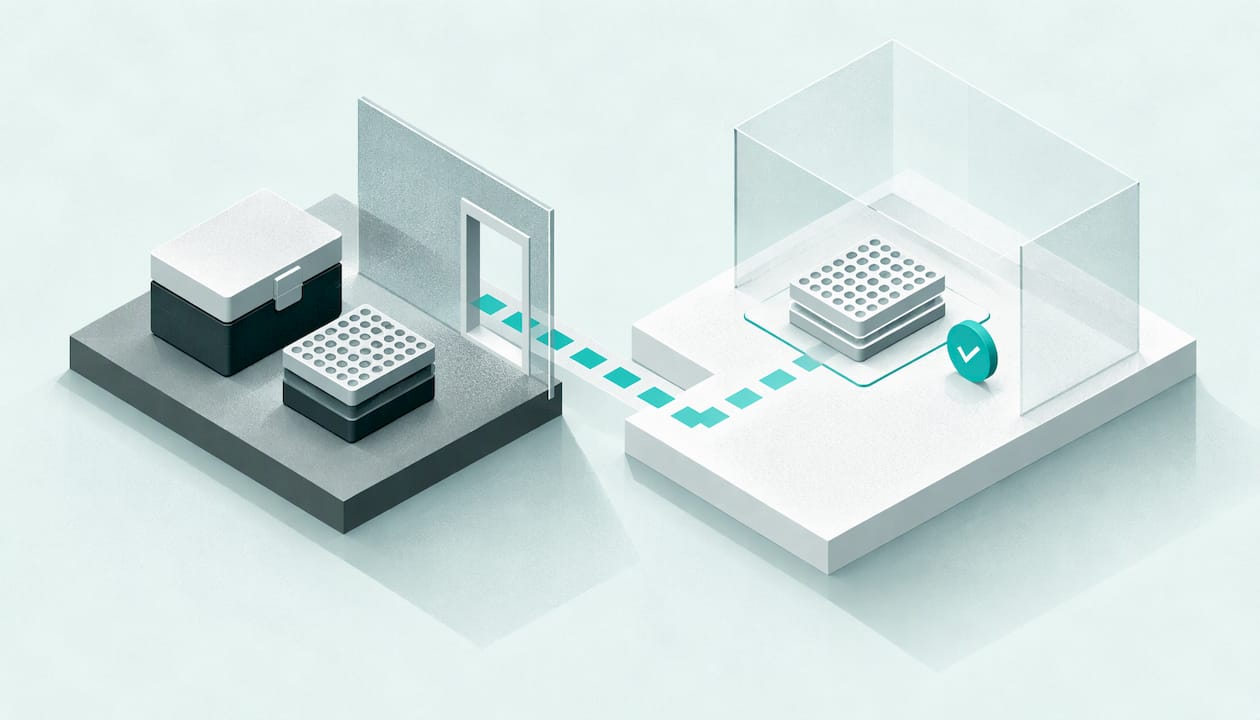
Contamination of a research peptide is prevented in three places: before the vial enters your lab, in storage, and at the bench. Start with a verified lot, because a certificate that matches the vial, a stated purity method and a lot-specific analysis remove most risk before you open anything. Then control temperature, moisture, light and repeated handling, and keep every tip, tube and column wash from carrying one peptide into the next. This guide sets out that routine for research laboratories in the UK. We supply 99%+ HPLC purity research peptides with Certificates of Analysis, strictly for laboratory use, and the routine below is the one we would hand a new postdoc.
TL;DR
- Check the paperwork on arrival: name, sequence, quantity and lot number must agree across the certificate, the vial and the delivery note. Quarantine any lot where they do not.
- Read purity properly. HPLC purity is not net peptide content, and neither proves that solvents, salts, endotoxin or by-products are absent.
- Store lyophilised stock cold, dry and dark, and aliquot once so you never freeze-thaw a working stock repeatedly.
- Use fresh tips for every vial, and flush the HPLC flow path between runs, because carryover is a contamination route in its own right.
- Discard any reconstituted solution that turns cloudy, shows particles, changes colour or has a damaged stopper, and record the lot in writing.
Table of Contents
- What "contamination" means for a research peptide
- Step 1: Verify the lot before it enters the lab
- Step 2: Store to stop degradation and moisture uptake
- Step 3: Weighing, reconstituting and aliquoting
- Step 4: Control carryover in the analytical path
- Warning signs and what to do about them
- UK requirements to keep in view
- How we supply research peptides
- Our view on contamination control
- FAQ
- Sources
What "contamination" means for a research peptide
The word covers several different problems, and each needs a different defence. Treating them as one is the commonest reason a lab believes it has "checked purity" when it has not.
Chemical impurities from synthesis. Solid-phase peptide synthesis leaves behind truncated sequences, deletion sequences, incompletely deprotected chains and residual reagents. A good purification step removes most of these, but they are the reason purity is quoted as a percentage at all.
Counter-ions, water and salts. A lyophilised powder is rarely all peptide. Laboratory Talk explains that HPLC purity can miss weakly absorbing species, water, inorganic salts and counter-ions such as trifluoroacetate, and that net peptide content, the mass fraction of actual peptide in the powder, is a separate value. If you weigh powder to make a molar stock without accounting for it, your concentration is wrong even when the peptide is pure.
Microbial and endotoxin contamination. Bacteria, fungi and bacterial endotoxin enter through non-sterile diluents, unclean stoppers, shared pipettes and long storage of solutions. For cell-based work, endotoxin can distort results long before any visible sign appears.
Cross-contamination at the bench. A reused tip, an unwashed column or a standard pipetted onto a tube wall can put one peptide into another sample. The authors of a peer-reviewed review of peptide handling for mass-spectrometry assays warn that reusing tips between vials causes carryover that can suppress low-abundance peptide signals or create false positives.
Degradation products. Strictly, degraded peptide is not foreign material, but it behaves like contamination: it is a species in your sample that you did not put there. The same review lists the routes: oxidation of cysteine, methionine and tryptophan, deamidation of glutamine and asparagine, hydrolysis of aspartic acid, and photochemical damage to aromatic residues.
The practical consequence is that prevention is a chain. A strong certificate does not protect a vial that sits at room temperature on a bench, and careful storage does not rescue a lot that was never properly characterised.
Step 1: Verify the lot before it enters the lab
The cheapest contamination control is the one you apply at the goods-in desk. Laboratory Talk's checklist for reading a certificate of analysis (COA) gives a sequence worth turning into a standing procedure:
- Match the product name, sequence and quantity on the COA to your order.
- Match the lot number across the COA, the vial label and the delivery note.
- Check the date of analysis and the identity of the issuing laboratory.
- Record the purity method and the detection wavelength.
- Separate HPLC purity from net peptide content.
- Compare observed and theoretical mass.
- Verify any claimed accreditation.
- Quarantine any discrepancy and query it in writing.
Two points deserve emphasis. First, the lot number is the thread that holds everything together. A certificate that describes an earlier production run tells you nothing certain about the vial in your hand. Second, quarantine means physically separating the vial and labelling it, not leaving it on the shelf with a note in your head.
What the numbers do and do not prove
A purity figure of 99% means that 99% of the integrated peak area at the chosen wavelength belongs to the main peak. It does not mean 99% of the powder is peptide, and it does not mean the main peak is the correct molecule. Mass spectrometry confirms the mass, but on its own it cannot tell leucine from isoleucine, or detect swapped residues of equal mass, or racemisation from L- to D-amino acids. Residue order needs MS/MS fragmentation, and stereochemistry needs a chiral method or an authentic reference.

If you want to go deeper on each piece, our guides cover how to read and judge an HPLC purity number, what LC-MS confirms and how to read a peptide certificate of analysis. For institutional procurement, the page on what a certificate must show for UK labs sets out a minimum content list you can adopt as an acceptance criterion.
Contaminant classes need their own tests
Residual solvents, elemental impurities, counter-ions and endotoxin are not revealed by a standard HPLC or identity result. If your assay is sensitive to any of them, the certificate needs a specific test for that class, with a method and a result. A statement that something is "absent" with no method behind it is not evidence. For cell work, read our note on what to check in peptide endotoxin testing and ask for the figure and unit before the lot is released to the bench.
A lot-release record is worth keeping even in a small group. One line per lot is enough: lot number, date received, who checked the COA, purity method, outcome, and storage location.
Step 2: Store to stop degradation and moisture uptake
Storage is where most avoidable losses happen. The mass-spectrometry handling review states that extended storage causes loss of solubility, concentration change from evaporation, adsorption to surfaces, microbial degradation, secondary-structure formation and chemical modification. Each of those can be limited by routine.
Keep lyophilised powder cold, dry and dark. Cold slows chemical reactions, dryness limits hydrolysis and deamidation, and darkness protects residues that degrade under light. Amber vials, or vials kept in a closed box, serve the last purpose.
Let the vial reach room temperature before opening. Opening a cold vial draws in moist air that condenses on the powder. Leave it sealed on the bench until it has warmed. This single habit prevents a good deal of caking and hydrolysis.
Limit freeze-thaw cycles. The review notes that oxidation is accelerated by freeze-thaw cycles and by high pH. If a sequence contains cysteine, methionine or tryptophan, repeated cycles are the main way you will damage a working stock. Aliquot once, freeze the aliquots, and thaw each only once.
Label and log everything. Peptide name, lot number, concentration, solvent, date prepared and your initials belong on every aliquot. When a result looks odd six weeks later, the label is how you trace it.
A fuller routine is in our peptide handling guidelines for UK research labs, and if you need to show how long a stock stays usable, see the practical guide to peptide stability testing.
Step 3: Weighing, reconstituting and aliquoting
This is the stage at which a clean, well-characterised lot is most often spoiled.
Prepare the workspace
Clean the bench and use a dedicated area where you can. Wear gloves, eye protection and a lab coat as a baseline, and follow the Safety Data Sheet for the specific material. Wipe the vial stopper with a suitable disinfectant wipe and let it dry before piercing it, so that the wipe's residue does not enter the solution.
Choose solvents and consumables deliberately
- Use fresh, sealed diluent from a clearly labelled container, never a stock bottle that has been opened repeatedly across a group.
- Use low-binding tubes where the peptide is hydrophobic or you are working at low concentration, since adsorption to plastic and glass lowers the effective concentration.
- Use a new sterile tip for every vial and every transfer.
- If you must correct for net peptide content, calculate it from the figure on the certificate before you weigh.
Some sequences carry residual salt that interferes with downstream work. When that matters, desalting methods and their common pitfalls are worth reviewing before you prepare the stock.
Dissolve gently
Swirl rather than shake. Vigorous agitation can foam the solution and promote aggregation. If the peptide does not dissolve, note it. Do not keep adding solvent until it appears to clear without recording what you did, because a changed solvent ratio changes the concentration and can change the structure.
Aliquot once
Divide the stock into single-use volumes sized to a single experiment. This removes repeated piercing of one stopper, repeated warming and cooling, and repeated opportunities for microbial entry. It also gives you a clean record: each aliquot is one use.
Step 4: Control carryover in the analytical path
Carryover is contamination you introduce yourself, and it matters most where your analysis is most sensitive.
The NCBI review recommends three habits. Pre-rinse pipette tips with the peptide solution so that adsorption to the tip does not strip the first aliquot. Add standards directly to the diluent rather than letting them sit on a tube wall. Run complete HPLC system washes to remove chromatographic carryover. The authors also note that hydrophobic peptides can remain retained on a column even after strong organic-solvent washes, so follow the manufacturer's published flow-path and column cleaning methods rather than improvising.
In practice:
- Run a blank injection after any high-concentration sample and before a low-concentration one.
- Order injections from low concentration to high wherever the design allows.
- Keep a column log, so a ghost peak can be matched to the preceding runs.
- If the question is whether a method resolves impurities well enough to trust, our comparison of HPLC and UPLC explains what higher resolution changes.
Warning signs and what to do about them
Some contamination is visible, much is not. Treat the visible signs as a reason to stop, not to push on.
| Sign | What it can indicate | Action |
|---|---|---|
| Persistent haze after gentle swirling and time to equilibrate | Aggregation or precipitation | Do not use. Record the solvent and lot. |
| Visible particles | Particulate matter, stopper fragments or precipitate | Discard the solution. |
| Colour change from the freshly made baseline | Oxidation or chemical modification | Discard and prepare fresh from a new aliquot. |
| Film at the liquid surface | Possible microbial growth | Discard. |
| Unusual odour | Degradation or microbial growth | Discard. |
| Damaged, cored or heavily punctured stopper | Loss of closure integrity | Stop using that vial. |
This table reflects common laboratory practice rather than a regulatory standard, so your own institution's SOP takes precedence. The point is to decide your discard criteria in advance and write them down, so nobody has to judge a borderline vial at the bench under time pressure.
If you suspect the lot itself rather than your handling, quarantine the unopened vials, keep the paperwork, and raise the discrepancy with the supplier in writing, quoting lot number and observation. An independent analytical re-test, with an endotoxin assay where relevant, gives you data to settle the question. Bear in mind that a limulus (LAL) endotoxin result is an analytical value only: it is not a sterility test and says nothing about suitability for any use outside the laboratory.
A supplier audit can also tell you whether the problem is isolated. Our guide to peptide vendor audits for UK labs lists what to request and what to look for.
UK requirements to keep in view
In a UK laboratory, the Control of Substances Hazardous to Health Regulations 2002 (COSHH) are the framework for handling chemicals. HSE's booklet on the COSHH assessment process gives employers step-by-step advice on assessing the substances their people work with. For a peptide, that means a written assessment that uses the supplier's Safety Data Sheet, names the controls (gloves, eye protection, handling in a suitable area) and covers waste disposal, with your institution's safety officer reviewing anything unusual.
Research peptides are supplied for in-vitro and laboratory research only. They are not for human or veterinary consumption, and nothing in a contamination protocol changes that. Our research use only page sets out how we supply them. If your institution has its own rules on purchasing and recording research chemicals, those apply on top.
How we supply research peptides
Prevention starts with what arrives. BioForgeUK supplies precision research peptides at 99%+ HPLC purity, with stringent quality controls, advanced verification processes and detailed product certifications, including Certificates of Analysis. That gives your goods-in check something concrete to work against: a document you can match to the lot number on the vial and the delivery note.
Our checkout is secure, and every product is supplied strictly for laboratory and scientific research. You can browse the range and see the certification we provide at BioForgeUK.

If you are setting acceptance criteria for a new lab, the certificate checks above are a ready-made starting point, and the guides linked throughout this article go through each one in turn.
Our view on contamination control
Most contamination stories we hear are really documentation stories. A lot is used before anyone has matched the certificate to the vial, a purity figure is read as if it meant something it does not, and months later the result cannot be explained.
That is why we put the emphasis on verification. A 99%+ HPLC purity figure is only useful when the Certificate of Analysis behind it is detailed enough for you to check it, and when quality controls sit behind the certificate rather than in front of it. We build our process around that, and we encourage every lab to hold us to it at goods-in.
The bench routine is the other half. Fresh tips, single-use aliquots, a cold dark store and a written discard rule cost almost nothing and prevent most of the problems that get blamed on the peptide.
Peptides are research materials, supplied for laboratory work only. We would rather you had a clean, documented lot and a simple routine than a clever one you cannot reproduce.
Neil
FAQ
How should peptides be stored to prevent contamination?
Keep lyophilised peptide cold, dry and protected from light, and let the sealed vial reach room temperature before you open it. Once dissolved, divide the solution into single-use aliquots so no stock is thawed repeatedly. Label each aliquot with lot number, concentration, solvent and date.
Does 99% HPLC purity mean the peptide is free of contaminants?
No. It means 99% of the detected peak area at the chosen wavelength belongs to the main peak. As Laboratory Talk notes, water, salts and counter-ions can go undetected, and net peptide content is a separate measure. Solvents, metals and endotoxin each need their own test on the certificate.
What causes cross-contamination between peptide samples?
The usual routes are reused pipette tips, standards left on tube walls and incomplete washing of the HPLC system. The peer-reviewed handling review cited above recommends pre-rinsing tips, adding standards directly to the diluent and running full system washes. Blank injections between high- and low-concentration samples show whether carryover is present.
What should I do if a reconstituted peptide looks cloudy?
Stop using it and record the lot, solvent and time. Persistent haze, particles, a colour change or a damaged stopper are all reasons to discard that solution and prepare fresh from an unopened aliquot. If the problem recurs across aliquots, quarantine the lot and query it with the supplier in writing.
Sources
- Certificates of analysis: are you reading or merely receiving your COAs (Laboratory Talk)
- Recommendations for the generation, quantification, storage and handling of peptides used for mass spectrometry-based assays (NCBI/PMC)
- A step by step guide to COSHH assessment, HSG97 (HSE)