
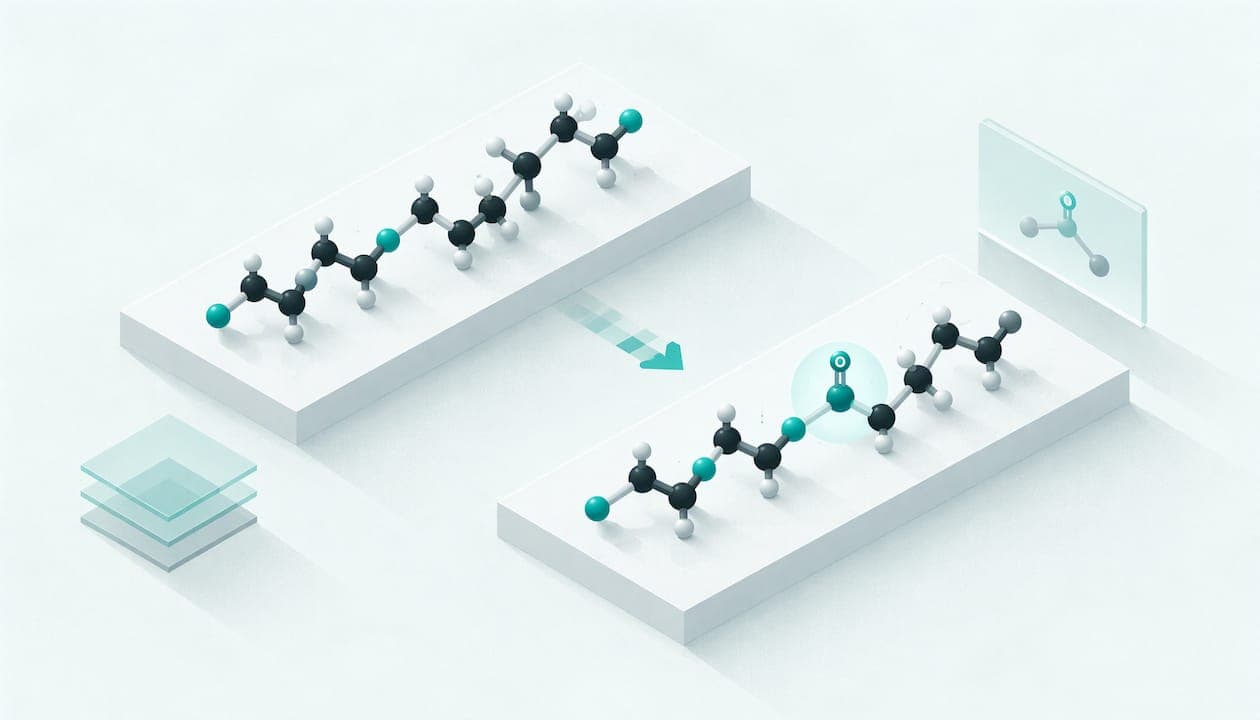
Peptide oxidation is a chemical change in which reactive oxygen species or other oxidising conditions modify vulnerable side chains, most often methionine and cysteine, and it can happen during synthesis, purification, storage and even analysis. You prevent it by limiting air, light, trace metals and freeze-thaw cycles, by storing peptides cold and dry, and by checking that what you detect was not created by your own workflow. This guide covers the chemistry, the practical effects, the detection methods and a handling routine for research labs.
TL;DR
- Methionine, cysteine, histidine, tryptophan, tyrosine and phenylalanine carry the most oxidation-prone side chains. Methionine sulfoxide (+15.995 Da) is the product you will meet most often.
- Oxidation can arise during production, purification and storage, and it is driven by oxygen species, light-driven photosensitisation and transition metals such as iron.
- Keep long-term stocks lyophilised at -20 to -80 °C, limit air exposure, avoid repeated freeze-thaw cycles and prepare working solutions close to use.
- Some oxidation is made by the LC-MS system, not the sample. Run a methionine-containing QC peptide to find out.
Table of Contents
- What peptide oxidation is
- Which residues are at risk
- What triggers oxidation
- What oxidation does to a sample
- How to prevent peptide oxidation
- Detecting and identifying oxidation
- Your instrument can oxidise your peptide
- Validating your prevention measures
- Starting with a well-characterised peptide
- Perspective
- FAQ
- Sources
What peptide oxidation is
Oxidation is one of several routes by which a peptide degrades. A 2011 Bioprocess International review separates chemical instability, meaning the formation or destruction of covalent bonds (oxidation, deamidation, reduction, hydrolysis), from physical instability such as unfolding, aggregation and precipitation.
The distinction matters at the bench:
- Hydrolysis cleaves peptide bonds.
- Deamidation converts amide-containing residues such as asparagine and glutamine.
- Oxidation changes side-chain chemistry, usually by adding oxygen to sulfur or to an aromatic ring.
- Aggregation is a physical association. It can follow oxidation, but it is not the same event.
Because oxidation starts as a covalent modification, it is not reversed by simply warming or diluting the sample. A modified peptide is a different molecule, and your assay will treat it as one.
For the wider picture of how long peptides keep and what shortens that time, see our guide to how long research peptides last.
Which residues are at risk
A 2019 review in Amino Acids identifies the sulfur-containing methionine and cysteine, plus the aromatic histidine, tryptophan, tyrosine and phenylalanine, as the most oxidation-prone among the 20 natural amino acids. The Bioprocess International review adds that the sulfur atom explains the vulnerability of Met and Cys, while the aromatic ring explains His, Trp and Tyr.
| Residue | Why it is vulnerable | What to watch for |
|---|---|---|
| Methionine | Sulfur atom | Sulfoxide (+15.995 Da), and slowly the sulfone (+31.99 Da) |
| Cysteine | Sulfur atom | Reversible and irreversible oxidation, sensitive to high pH |
| Tryptophan | Aromatic ring | Multiple oxidation products, light and metal sensitivity |
| Histidine | Aromatic ring | Metal-catalysed oxidation |
| Tyrosine, phenylalanine | Aromatic ring | Less reactive, but susceptible under harsher conditions |
The mass shifts for methionine come from a 2015 Journal of Chromatography B article, which describes methionine S-oxide as the major oxidation product. It also reports that it can account for up to 10% of the non-redundant peptide sequences identified in typical bottom-up LC-MS experiments. Intense oxidation can push the sulfoxide on to the sulfone, but that step proceeds much more slowly.
If your sequence contains Met, Cys or Trp, treat it as an oxidation-sensitive peptide from the day it arrives.
What triggers oxidation
The same Amino Acids review notes that oxidation may result from photosensitisation or transition-metal catalysis, and that it can occur during production, purification and storage. In practice the triggers fall into four groups.
Oxygen and reactive oxygen species
Dissolved oxygen, peroxides in reagents and radicals from other reactions all attack susceptible side chains. Peptide-handling recommendations in a peer-reviewed PMC paper advise limiting air exposure and using inert gas for particularly sensitive sequences.
Light
Visible and UV-A light are the main light components that formulations meet during manufacture and storage. A 2022 PMC article by Schöneich points out that individual amino acids do not absorb visible light, and that at best tryptophan, tyrosine, histidine and cystine show negligible UV-A absorbance. Direct photolysis is therefore rarely the main route. Photosensitisation, where another light-absorbing species or additive drives the chemistry, is the more likely concern, which is a good reason to keep solutions out of bright light.
Trace metals
Iron and copper catalyse oxidation. They can come from buffers, glassware, stainless-steel needles and column hardware. The next section returns to this, because the same metals also inflate oxidation in your measurements.
pH and freeze-thaw cycles
The PMC handling recommendations state that cysteine, methionine and tryptophan are prone to reversible and irreversible oxidation, and that freeze-thaw cycles and high pH accelerate it. Alkaline buffers are particularly unkind to cysteine-containing sequences.
What oxidation does to a sample
The consequences range from a subtle chromatographic shift to a loss of function.
- Altered structure and activity. A Leiden University review states that oxidation can alter higher-order structure, induce aggregation and produce species that are less biologically active than the native molecule.
- Aggregation or fragmentation. The Bioprocess International review reports that oxidation can change folding and subunit association and lead to aggregation or fragmentation.
- Shifted retention and mixed peaks. Methionine oxidation forms a mixture of R,S and S,S diastereomers at the sulfur atom, so one oxidation event can produce two closely eluting species.
- Changed quantitation. If part of your peptide has moved to the oxidised form, a calibration based on the intact mass will under-read.
For a research lab, the practical message is simple: an oxidised fraction is not just a purity number, it is a variable in your experiment.
How to prevent peptide oxidation
The routine below follows the peer-reviewed handling recommendations and the residue chemistry above. Adapt it to your sequence.
- Know your sequence. Flag every Met, Cys, Trp, His and Tyr before the vial is opened. Sensitive sequences get the strictest handling.
- Store lyophilised, cold and sealed. The PMC recommendations find that long-term storage beyond six months is most effective in lyophilised form at -20 to -80 °C. Our lyophilised peptide storage guide walks through the details.
- Limit air exposure. Open vials briefly, reseal promptly and use inert gas such as nitrogen or argon for particularly sensitive sequences.
- Make working solutions close to use. Reconstituted stock solutions are best kept frozen at or below -70 °C, according to the same recommendations. Our peptide reconstitution guide covers solvents and technique.
- Aliquot. Dividing a stock into single-use portions avoids repeated freeze-thaw cycles, which accelerate oxidation of Cys, Met and Trp.
- Watch the pH. Avoid high-pH buffers for cysteine-rich or methionine-rich peptides unless the experiment requires them.
- Control metals and peroxides. Use clean plasticware or properly rinsed glassware, high-grade reagents and, where compatible with your assay, a chelator such as EDTA. A 2012 study by Ji and colleagues found that EDTA gave more consistent oxidation measurements in both phosphate and Tris buffers, and that cleaning detergents containing low levels of peroxide should be avoided for glassware.
- Protect from light. Use amber tubes or foil for solutions, especially those holding tryptophan.
Supporting handling routines are laid out in our peptide handling guidelines for UK research labs.
Buffer choice matters more than most people expect
In the same Ji study, phosphate buffer contained higher residual metals than Tris and induced more oxidation during protein digestion. If you see unexplained oxidation in a digestion or dilution step, the buffer is a sensible first suspect.
Detecting and identifying oxidation
A 2019 PMC review by Hawkins and Davies lists many ways to quantify oxidative modifications: HPLC or UPLC with UV, fluorescence, electrochemical or mass-spectrometric detection, GC-MS and immunological methods such as immunoblotting and ELISA. For peptides, LC-MS is the usual choice.
The mass-spectrometry signature
Methionine sulfoxide adds 15.995 Da, and methionine sulfone adds 31.99 Da, as set out in the 2015 Journal of Chromatography B article. Oxidised peptides usually elute slightly earlier on reversed-phase columns than their intact forms. If you are new to interpreting spectra, our guide to reading mass spectra of peptides is a useful companion.
Telling real oxidation from artefact
This is where many labs lose time. Unintentional oxidation occurs mainly during sample preparation and handling, and electrospray ionisation can also induce it. The 2015 article notes that in-source oxidation can usually be recognised because the modified and unmodified peptides show identical elution profiles.
The Hawkins and Davies review describes a stronger approach for methionine: fully oxidise all Met residues with H2 18O2, then use the +2 Da mass shift from 18O incorporation to separate artefactual oxidation from oxidation that was already in the sample. It also cautions that methionine sulfoxide is not always a marker of freely diffusing oxidants, since it can be produced enzymatically on proteins by MICAL-family enzymes.
The two sulfoxide diastereomers can be distinguished with the methionine sulfoxide reductases MsrA and MsrB, and a 2012 BMC Biochemistry study used Msr-dependent reduction to confirm that hydrogen peroxide oxidation of methionine-rich proteins was specific to Met.

Use more than one method
A Journal of Biological Chemistry review recommends complementary analytical methods, quantitative rather than purely qualitative measurement, and checking both the loss of the parent peptide and the formation of modified products, because single-method results can mislead.
Your instrument can oxidise your peptide
The analytical workflow is part of the oxidation problem. Three findings are worth knowing.
- Metals in the flow path. Ji and colleagues identify residual metals, especially iron, in digestion buffer, columns, injectors and other contact surfaces as major causes of variability in methionine oxidation measurements. They also report that a stainless-steel injection needle can raise oxidation after multiple injections from the same vial, probably because acidified digest exposes the needle and introduces iron.
- Column age and gradient length. A 2021 Journal of Chromatography A study by Baumans and colleagues showed that the status of an LC setup can cause artefactual oxidation in routine analysis and quality control. Oxidation increased with column age and gradient length.
- A simple fix. The same study recommends a QC standard containing a methionine-containing peptide, so that the system's oxidation contribution can be followed over time.
So if a freshly opened vial shows 5% methionine sulfoxide, check your system before you blame the supplier or the storage. Re-injecting from the same vial several times, a long gradient on an ageing column, or an unflushed injector could all be responsible. Our comparison of HPLC and UPLC covers how run times differ, and our guide to HPLC calibration peptides explains how to build system checks.
Validating your prevention measures
Prevention is only credible if you can show it works for your peptide and your experiment.
Run a stress test
A 2022 review on oxidation during drug product development describes forced degradation as a way of identifying likely oxidative degradation products, establishing susceptibility and mechanism, and supporting stability-indicating methods. In a research setting, that can mean deliberately exposing a small aliquot to a mild oxidant and noting where your method places the products. Then you know what oxidation looks like in your own data.
Monitor routinely
- Inject a methionine-containing QC peptide periodically to follow LC-induced oxidation.
- Record column age and gradient length alongside the result.
- Compare an aliquot kept at -80 °C with one that has been handled normally.
Validate the method itself
A 2022 Analytical and Bioanalytical Chemistry study reports that site-specific LC-MS peptide mapping can monitor methionine and tryptophan oxidation and be validated for accuracy, precision, linearity, range, quantitation limit, specificity and solution stability. That is a useful checklist for any quantitative oxidation assay.
Our peptide stability testing guide sets out a wider practical framework.
Starting with a well-characterised peptide

Prevention begins before the vial reaches your freezer. BioForgeUK supplies research peptides with 99%+ HPLC purity, supported by Certificates of Analysis, so that your baseline is documented when the peptide arrives. Reading that paperwork properly helps you separate what was in the vial from what your handling or instrument added later: our guide to the peptide certificate of analysis shows how.
Browse the range and order through our secure checkout at BioForgeUK. All products are supplied strictly for laboratory and scientific research, not for human or veterinary consumption.

Perspective
Most oxidation problems we hear about are really baseline problems. A researcher sees a +16 Da peak and cannot tell whether it was in the vial, formed on the bench or appeared in the autosampler.
That is why we put so much weight on documented purity. We supply research peptides at 99%+ HPLC purity with Certificates of Analysis, because a known starting point is what makes every later question answerable. When you can read the CoA and trust it, oxidation becomes something you can trace rather than guess at.
Our advice is practical. Treat any sequence with methionine, cysteine or tryptophan as sensitive. Aliquot on day one, keep stocks cold and sealed, and run a methionine QC peptide so your instrument is accounted for. Good verification at the supplier and good habits in the lab work together.
Neil
FAQ
Is methionine oxidation reversible?
In biology, methionine sulfoxide can be reduced back by the Msr enzymes, and MsrA and MsrB act on different diastereomers. In a stored vial or a prepared sample there is no such repair, so the practical aim is to prevent it. Further oxidation to the sulfone is much slower but does not revert in the same way.
How can I tell whether oxidation happened in storage or during analysis?
Look at the chromatography. In-source oxidation shows the modified and unmodified peptides eluting together, as the 2015 Journal of Chromatography B article notes. For a firmer answer, run a methionine-containing QC peptide and check whether oxidation rises with column age, gradient length or repeated injections from one vial.
What is the best way to store peptides to avoid oxidation?
For storage beyond six months, published handling recommendations favour the lyophilised form at -20 to -80 °C. Keep vials sealed, limit air exposure, and use inert gas for sensitive sequences. Freeze reconstituted solutions at or below -70 °C in single-use aliquots.
Which amino acids oxidise most easily?
Methionine and cysteine, because of their sulfur atoms, and the aromatic residues histidine, tryptophan, tyrosine and phenylalanine. Methionine, cysteine and tryptophan are the ones to watch most closely during routine handling.
Does adding EDTA help?
It can help where it is compatible with your assay. In the 2012 study of residual metals, EDTA added to phosphate and Tris buffers gave more consistent methionine oxidation measurements. Check that a chelator will not interfere with your downstream application first.
Sources
- Biopharmaceutical Product Stability Considerations, Part 1 (Bioprocess International)
- Susceptibility of protein therapeutics to spontaneous chemical modifications (Amino Acids)
- Advanced Oxidation Processes in Pharmaceutical Formulations (PMC)
- Recommendations for the generation, quantification, storage and handling of peptides (PMC)
- Chromatographic behavior of peptides containing oxidized methionine residues (J Chromatogr B)
- Oxidation of Therapeutic Proteins and Peptides: Structural and Biological Consequences (Leiden University)
- Detection, identification, and quantification of oxidative protein modifications (PMC)
- Residual metals cause variability in methionine oxidation measurements (ScienceDirect)
- Liquid chromatography setup-dependent artefactual oxidation of peptides (J Chromatogr A)
- Characterization of methionine oxidation and methionine sulfoxide reduction (BMC Biochemistry)
- Detection, identification, and quantification of oxidative protein modifications (Journal of Biological Chemistry)
- Oxidation of Drugs during Drug Product Development (PMC)
- Development, validation, and implementation of a robust peptide mapping method (Analytical and Bioanalytical Chemistry)