
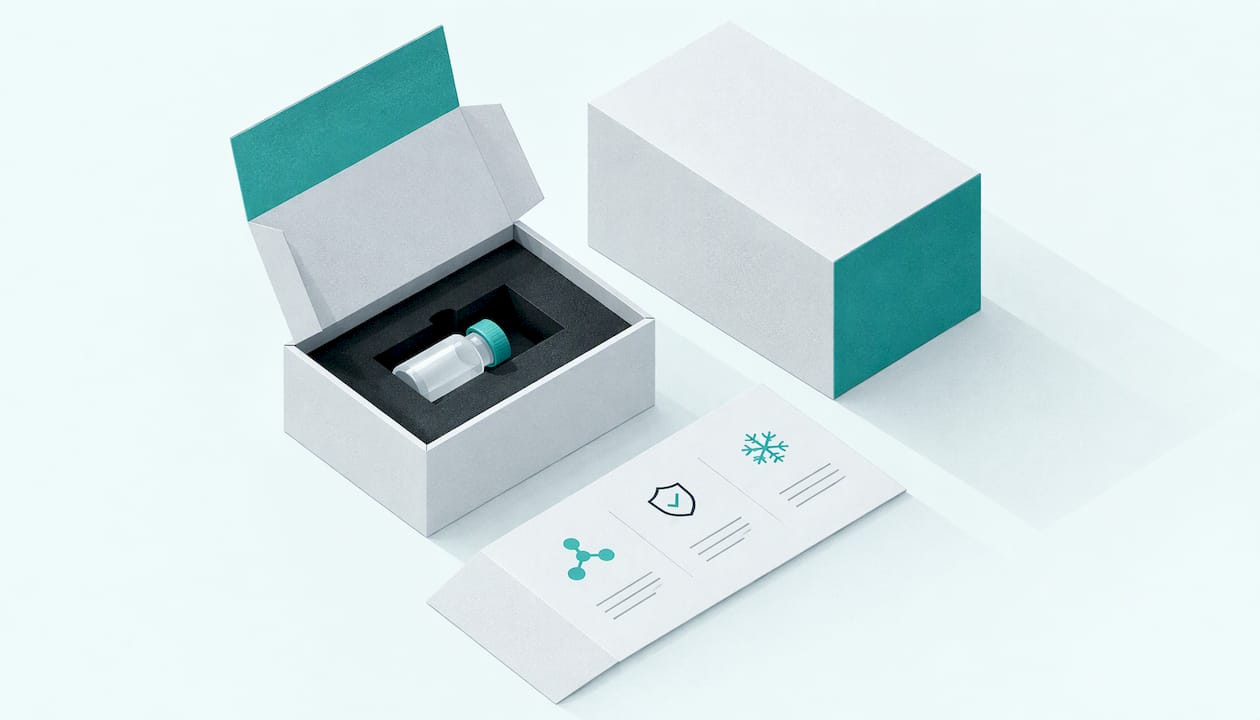
There is no single "peptide packaging standard" in the UK. Packaging for research peptides is shaped by three things: chemical classification and labelling law (GB CLP), general principles for protecting a product from light, moisture and damage, and the storage needs of the peptide itself. This guide sets out what each requires, what a well-packed delivery looks like, and how to check an order when it arrives.
TL;DR
- Research peptides sold in Great Britain fall under CLP rules on classifying, labelling and packaging, where the substance meets the criteria. Importers carry those duties too.
- A reduced-labelling exemption exists for small inner packs (10 ml or less) sold for research, but only when the outer packaging meets the full requirements.
- Good packaging protects against light, moisture, oxygen, contamination and mechanical damage, and the container must not react with, leach into or absorb the contents.
- A Certificate of Analysis and a research-use-only label describe a batch and its intended use. They do not replace your own receiving checks.
- Inspect on arrival: seal, vial, label, temperature handling, paperwork. Record what you find before storing.
Table of Contents
- Is there a formal packaging standard for research peptides?
- What the law says about packaging and labelling
- What good vial packaging looks like
- Packaging for lyophilised peptides versus solutions
- Shipping and temperature control
- A receiving routine for research buyers
- What packaging, a CoA and an RUO label can and cannot tell you
- Importing peptides into the UK
- Order research peptides for your lab
- FAQ
- Sources
Is there a formal packaging standard for research peptides?
Not as one document. Peptides intended for laboratory work are chemicals, not licensed medicines, so no pharmacopoeial monograph dictates the vial, stopper or box. What exists is a stack of obligations and good practice:
- Legal labelling and packaging duties under the CLP Regulation, which in Great Britain operates as retained law and is enforced through the HSE.
- Recognised packaging principles borrowed from pharmaceutical guidance, such as the WHO guidelines on packaging for pharmaceutical products.
- Peptide-specific handling needs: lyophilised powders are hygroscopic and often temperature-sensitive, so the pack has to keep them dry, dark and cool.
- Supplier quality documentation, usually a Certificate of Analysis (CoA) tied to a batch number.
A competent supplier works to all four. As a buyer, knowing the four layers tells you what a delivery should show and what it cannot.
What the law says about packaging and labelling
CLP duties for suppliers and importers
CLP requires manufacturers, importers and suppliers to classify, label and package hazardous substances and mixtures before they are placed on the market. The HSE's Northern Ireland guidance explains that where required, substances must be classified, labelled and packaged according to CLP before supply. For Great Britain, the HSE's page on the duties of a GB-based importer covers what a business importing substances from the EU or elsewhere must do, including keeping information used for classification and labelling for a set period after last supply.
Two practical points follow for a lab buyer:
- If a peptide is imported to the UK for sale, the importer, not the lab, carries the classification and labelling duty. The label you receive should therefore reflect it.
- Many research peptides have not been fully assessed for hazards. The absence of a pictogram does not mean a substance is harmless. Handle every research peptide under your institution's COSHH risk assessment.
What a CLP label contains
The CLP annex sets out the form of the elements. Hazard pictograms must be a square set on a point, with a black symbol on a white background and a red frame wide enough to be clearly visible. If you want a refresher on what each symbol means, see our guide to GHS pictograms and their meanings.
The same annex says the label on inner packaging must carry at least the hazard pictograms, a product identifier and the supplier's name and telephone number. In practice, a good peptide vial label also shows the following, which are standard laboratory practice rather than legal minimums:
- Peptide name or code and sequence reference
- Batch or lot number that matches the CoA
- Net quantity of lyophilised material
- Storage temperature instruction
- A clear "for research use only, not for human or veterinary use" statement
The small-pack research exemption
Peptide vials are usually tiny. CLP recognises that and provides a reduced labelling route. The annex states an exemption applies where the inner packaging holds no more than 10 ml, the substance is placed on the market for scientific research and development or quality control analysis, and it sits in an outer packaging that meets the Article 17 requirements.

The consequence is worth understanding. On a 2 ml or 5 ml vial you may see a shorter label than on a litre bottle, because the full information sits on the outer box. That is why the outer packaging matters: if the box and the vial are separated, you lose labelling. Keep the original outer pack or transcribe its information into your inventory record the day the order arrives.
What good vial packaging looks like
The WHO guidelines on packaging for pharmaceutical products give the clearest general principle. Packaging should protect the product against all adverse external influences that may affect its quality or potency, listing light, moisture, oxygen, biological contamination and mechanical damage. It also says the packaging itself must not harm the product through chemical reactions, leaching or absorption. Those two sentences translate neatly into a peptide checklist.
| Risk | What the packaging should do | What you can see on receipt |
|---|---|---|
| Moisture | Keep lyophilised powder dry with a tight closure | Intact stopper and crimp cap, cake looks dry and uniform |
| Light | Limit exposure for light-sensitive sequences | Amber glass or an opaque outer box |
| Oxygen | Limit headspace exchange | Properly seated stopper, no visible gap |
| Contamination | Sealed, clean primary container | Tamper-evident seal unbroken, no residue on the neck |
| Leaching or sorption | Inert container and closure | Glass vial with a suitable stopper, no discolouration |
| Mechanical damage | Immobilise the vial in transit | Insert or padding, no movement inside the box |
Primary container: the vial and closure
The usual format is a glass vial with a rubber or elastomer stopper and an aluminium crimp. Glass is chosen because it is chemically inert and does not absorb peptide the way some plastics can. Typical sizes are in the low millilitre range, which also matches the 10 ml threshold in the CLP exemption above.
The stopper deserves as much attention as the glass. A poorly seated stopper lets in moisture over weeks, and a lyophilised peptide is hygroscopic. Our guide to peptide storage containers goes through vials, boxes and freezer set-up in more detail.
Secondary packaging: box, insert and outer carton
The box does three jobs: it carries the full label information when the vial label is reduced, it blocks light, and it holds the vial still. An insert that fits the vial closely prevents the glass-on-glass contact that causes chips and cracked necks. Where several vials ship together, each should be separated.

Packaging for lyophilised peptides versus solutions
Most research peptides are supplied as a lyophilised powder, because that is the most stable form. Packaging needs differ by state:
- Lyophilised powder: needs a dry, sealed container, protection from light and a stable cool temperature. General supplier guidance for lyophilised peptides is to store them desiccated, commonly at -20°C for longer periods. Check the instruction for your specific sequence rather than assuming. Our lyophilised peptide storage guide covers the practicalities.
- Peptides in solution: are far less stable and more exposed to degradation, microbial growth and aggregation. Solutions are generally prepared in the lab as needed and aliquoted, so you avoid repeated freeze-thaw cycles. See our notes on peptide reconstitution and on peptide aggregation.
Whatever the state, how long a peptide lasts depends on the sequence, the storage and the handling. We explain the factors in our peptide stability article, and how a lab can test it in peptide stability testing.
Shipping and temperature control
Packaging does not end at the vial. The shipment as a whole needs a plan, and the right one depends on the peptide, the season and the transit time.
- Ambient shipping is common for lyophilised peptides over short UK transit times, because the dry powder tolerates brief exposure to room temperature. Sequences with known sensitivity may need a cold pack or insulated carton.
- Insulated cartons with cool packs protect against summer heat in vans and sorting centres. The pack should keep the coolant from touching the vials directly, to avoid condensation on labels and closures.
- Dry-ice shipments are rarer for research peptides, and the carrier has its own rules for them.
The point for a lab is to match the shipment to what the peptide needs, then record what actually happened. A parcel left on a doorstep or in a warm porter's room for a day is a handling event, even if the box looks fine. Tell your goods-in team which deliveries are temperature-sensitive so they are not parked with ordinary mail. For internal procedures after arrival, see our peptide handling guidelines for UK research labs.
A receiving routine for research buyers
A ten-minute check at the door protects weeks of experimental work. Here is a routine that works in most labs.
- Check the outer box. Look for crushing, wetness, tears or signs of tampering. Photograph any damage before opening.
- Record the time and conditions. Note the date, time received, how long it may have sat in a delivery area, and whether any coolant is still cold.
- Compare the label with your order. Peptide name or code, quantity and batch number should match the packing list and the CoA.
- Inspect each vial. The cap should be crimped fully, the stopper seated, the glass free of cracks or chips. The lyophilised cake should look intact. A powder smeared up the walls may mean the vial was shaken or warmed, though many freeze-dried cakes are naturally uneven.
- Read the storage instruction and move the vial to the correct location at once. Keep it sealed and in its box until you need it.
- File the paperwork. Store the CoA with the batch number in your inventory system. Keep the outer packaging information if the vial label is reduced under the research exemption.
- Log any deviation and contact the supplier the same day, with photographs.
A supplier with good records will welcome a prompt report, because batch traceability is what lets them investigate.
What packaging, a CoA and an RUO label can and cannot tell you
It helps to be exact about what each piece of evidence establishes.
| Item | It can establish | It cannot establish |
|---|---|---|
| Intact packaging | The vial was not obviously breached in transit | That the contents are pure, or that temperature stayed in range |
| Batch label | Traceability to a production lot | The purity of the material in your hand |
| Certificate of Analysis | The results of tests on a batch, such as HPLC purity and identity | How the vial was handled after release, or your own storage history |
| Research-use-only label | The intended use and the supplier's legal position | That the peptide is safe for any use beyond the laboratory |
A CoA is a record of test results, and it is only as useful as the batch number linking it to your vial. Labs that need to confirm identity or purity independently can run their own analysis. That is standard practice in analytical work, and it is why reference materials exist. Our piece on HPLC calibration peptides covers the standards labs use for such checks.
The research-use-only wording matters legally and practically. It signals that the product is supplied for laboratory work, not for human or veterinary use. We explain what it means for UK buyers in research use only peptides: what the label means.
Importing peptides into the UK
Readers often ask whether peptides can be imported at all. For laboratory chemicals, the answer turns on classification and labelling first. The HSE's Northern Ireland guidance says that when you place a substance on the market by importing it, you are treated as an importer under CLP and must classify, label and package in line with it. For Great Britain, the HSE sets out the specific duties of a GB-based importer, and the rules differ between Great Britain and Northern Ireland, so check the page that applies to your site.
Separate rules can apply to particular substances, such as controlled drugs or medicines, and to products meant for human use. If your work involves any of those, ask your institution's compliance or biosafety officer before ordering. Peptides sold for research should be bought only by qualified purchasers for laboratory use.
Our view on packaging
We think of packaging as part of the product, not a wrapper around it. A 99%+ HPLC purity result means little if moisture, light or a loose closure undo it between our bench and yours.
That is why we pair each research peptide with batch-level documentation, including a Certificate of Analysis, and why every product is supplied strictly for laboratory and scientific research, never for human or veterinary consumption. Our quality controls and verification processes are built so you can trace a vial to a batch and a batch to its test results.
When you receive any peptide, from us or anyone else, run the receiving routine above. Good labs do this by habit, and it is the best protection for your data.
Neil
Order research peptides for your lab
If you are sourcing peptides for laboratory work, BioForgeUK supplies precision research peptides at 99%+ HPLC purity, backed by quality controls, Certificates of Analysis and a secure checkout. Everything we sell is for research use only. Read the terms on our research use only page, then browse the range at BioForgeUK.

FAQ
What should I store my peptides in?
Keep lyophilised peptides in their original sealed glass vial, inside the outer box or an opaque container, and place them at the temperature given for that peptide. Many labs use a freezer at -20°C for longer-term storage. Use clean, tightly closing tubes for aliquots of reconstituted material.
Are research peptides labelled under CLP?
Where a substance meets the hazard criteria, CLP requires classification, labelling and packaging before it is supplied. A reduced label can apply to inner packs of 10 ml or less sold for research, when the outer packaging carries the full information. Keep the outer packaging details with your records.
Does a Certificate of Analysis guarantee my vial is still intact?
No. A CoA reports test results for a batch at release. What happens in transit and storage is covered by your receiving checks and your own storage records. Matching the batch number on the vial to the CoA is the first step.
Do I need cold-chain shipping for every peptide?
Not always. Many lyophilised peptides tolerate short ambient transit, but some sequences are more sensitive. Follow the storage and shipping instruction for the specific peptide, and log the delivery time and condition when it arrives.
What should I do if a vial arrives damaged?
Photograph the outer box and the vial before touching anything else, record the batch number and report it to the supplier the same day. Quarantine the vial and do not use it in experiments until the issue is resolved.
Sources
- HSE Northern Ireland: An overview on what you need to do (CLP)
- HSE: Duties of a GB-based importer
- Regulation (EC) No 1272/2008, Annex I (legislation.gov.uk)
- WHO Annex 9: Guidelines on packaging for pharmaceutical products