
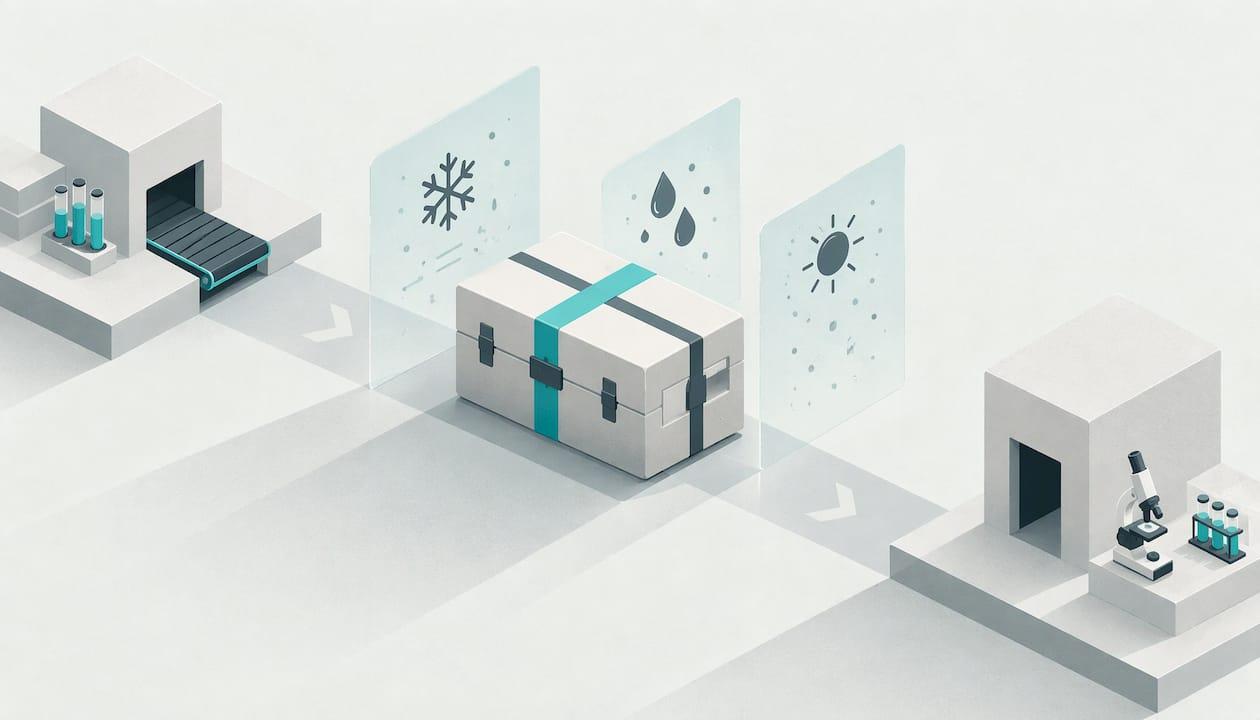
A research peptide survives transit when three things are controlled: its form (lyophilised powder travels far better than a solution), its packaging (cushioned, sealed, shielded from heat and light) and its paperwork (so your lab can show what arrived and in what state). Get those right and a parcel that spends two or three days in the UK courier network arrives as the material you ordered. Start from a supplier whose product is documented, with 99%+ HPLC purity and a Certificate of Analysis (CoA) you can match to the vial, and the arrival check becomes a straightforward comparison rather than guesswork.
This guide covers the conditions that matter for UK laboratories, the rules around dry ice, and a practical receiving routine. All peptides discussed are for laboratory and scientific research only, not for human or veterinary consumption.
TL;DR
- Lyophilised (freeze-dried) peptide is the most transit-tolerant form; solutions are far more vulnerable to warmth and should travel frozen if they must travel at all.
- Good packing means a cushioned vial, a sealed bag, padded gaps, taped seams and light protection, with extra thermal protection only for hot weather or long routes.
- Royal Mail and Parcelforce do not accept dry ice; express couriers do, under IATA and ADR rules, and the box must be labelled correctly.
- Receiving is a routine: inspect the outer box, the seal, the vial and the cake, match the batch to the CoA, log the arrival and move the vial to storage promptly.
Table of Contents
- Why transit conditions matter for peptides
- Lyophilised powder or solution: the first decision
- Temperature: ambient, cool pack or dry ice
- Packaging that holds up
- Timing and carriers within the UK
- Paperwork that should travel with the parcel
- What to check when a shipment arrives
- Excipients and why they influence transit tolerance
- Our perspective
- Sourcing documented peptides for your lab
- FAQ
- Sources
Why transit conditions matter for peptides
A peptide in transit faces heat, moisture, light and mechanical shock. Most chemical degradation routes in peptides, such as asparagine deamidation, methionine oxidation, hydrolytic cleavage and disulfide exchange, speed up with temperature following Arrhenius behaviour. A 2026 Peptide Science Journal article on mean kinetic temperature points out the consequence: short warm spells weigh disproportionately, so six hours at 45°C does more damage than a simple average temperature would suggest.
The same article notes why lyophilised material copes well. A well-freeze-dried cake is an amorphous glass whose glass transition temperature (Tg, the point at which it softens) is commonly above 40°C. Below that point molecular movement, and therefore degradation, is very slow. That is why a short ambient journey is defensible for lyophilised powder, and why a brief logger spike in summer does not automatically mean the vial is spoiled.
Two practical conclusions follow:
- The form you order decides how demanding the journey is. Powder is forgiving; reconstituted solution is not.
- What you want from shipping is not perfection but a short, protected, documented journey, so any excursion is small and visible.
For the longer-term picture after arrival, our guide to peptide stability explains how long research peptides last and which factors shorten that.
Lyophilised powder or solution: the first decision
Order and receive peptides as lyophilised powder wherever your protocol allows. Water removal is what gives the material its stability, and the vial stays sealed until you decide to reconstitute it in your own controlled conditions. Reconstituted solutions can degrade within hours when warm, so a solution that has to move between sites should travel frozen and be declared as a solution on the paperwork.

This also keeps the receiving lab in control of the step with the most variables. How you dissolve a peptide, which solvent you use and at what concentration are all decisions that depend on sequence and charge. Our guides to peptide reconstitution and the peptide solubility guide cover them once the vial is on your bench.
Temperature: ambient, cool pack or dry ice
Three levels of thermal protection are in use. Which one fits depends on the form of the peptide, the route and the season.
| Protection | Typical temperature | When it fits |
|---|---|---|
| Insulated or padded box, no cold source | Buffers ambient swings | Lyophilised powder on short to moderate UK routes in mild weather |
| Gel or phase-change cold pack in an insulated liner | Roughly 2–8°C | Hot months, longer routes, or material you want to keep cool |
| Dry ice | Around −78°C | Frozen solutions or material genuinely unstable at ambient |
Two cautions apply. First, a cold pack does not prove what the vial experienced. A thawed pack tells you the refrigerant was exhausted, not when, so a data logger is the only real record of the journey. Second, dry ice is not automatically the "safer" choice. Direct contact with dry ice can crack a small glass vial through thermal shock, and for lyophilised powder a gel pack is usually the more suitable tool when extra protection is warranted.
For long-term storage after arrival, lyophilised peptide is commonly held at −20°C, while liquid preparations are typically kept at 2–5°C. Our lyophilised peptide storage guide sets out the freezer routine in practical detail.
Packaging that holds up
A sound pack-out is simple and layered. Working from the vial outwards:
- Cushion each vial individually. A foam insert or sized holder stops glass-on-glass contact and absorbs knocks.
- Seal the holder in a bag. This keeps out moisture and contains any leak or breakage.
- Protect from light. Amber vials or opaque wrap matter for light-sensitive sequences.
- Fill voids. Movement inside the box is what breaks vials, so pad every gap.
- Tape every seam, and add a tamper-evident seal if your quality system uses one.
- Add thermal protection only where the route calls for it, in an insulated liner with enough refrigerant for the longest realistic transit time plus a delay buffer.
The point of this layering is that each step is cheap and each failure it prevents is expensive: a cracked vial or a compromised seal can mean a lost batch and a delayed experiment. Our overview of peptide packaging standards for UK research labs goes through what each layer should achieve, and the guide to peptide storage containers covers vials, boxes and freezer set-up once the material is in your lab.
Timing and carriers within the UK
Weekends are the hidden risk. A parcel dispatched on a Thursday or Friday can sit in a depot for two days with no temperature control, which is why careful senders ship early in the week and avoid weekend holds. For the same reason, a tracked, time-defined service is worth more than the cheapest option, especially between June and September.
If you are the sender, for example moving samples between two sites, the carrier question is about dry ice more than anything else. Royal Mail and Parcelforce do not accept dry ice. Private express carriers such as DHL, FedEx and UPS accept it when it is prepared under IATA provisions for air and ADR provisions for road.
Dry ice rules in brief
Dry ice is classed as a dangerous good (UN 1845, Class 9). For air transport it falls under IATA Packing Instruction 954. In practice that means:
- a vented, rigid, insulated outer package, since sealing a box tightly with dry ice inside lets carbon dioxide build up pressure;
- the words "Dry Ice" or "Carbon Dioxide, solid", the UN 1845 number and the net weight of dry ice marked on the package;
- the dry ice quantity declared on the air waybill;
- a carrier approved to handle dangerous goods, agreed before collection.
The same source covers the labelling and quantity limits in more detail; check the carrier's own current requirements before you book, because they are updated periodically. For most lyophilised research peptides none of this is needed, which is one more reason to prefer powder.
Paperwork that should travel with the parcel
Documentation is part of the shipping condition, not an afterthought. A shipment that can be identified, traced and reconciled is one your lab can accept with confidence. A complete set normally includes:
- a commercial or pro-forma invoice and a packing list;
- a sample description giving the name, quantity, format and stated storage temperature;
- a safety data sheet (SDS) where one applies;
- the batch's Certificate of Analysis;
- a tracking number, and for high-value material a temperature logger with downloadable data.
Keep a copy in the box and send electronic copies ahead of dispatch, so the receiving team knows what to expect and can flag a mismatch on day one.
The CoA deserves particular attention. It ties a batch number to measured results, typically HPLC purity and mass confirmation. When the vial label, the batch number and the CoA agree, you have a verifiable starting point; when your protocol is sensitive, that is the document you will return to if a result looks odd. Our guide to peptide stability testing explains how to judge whether a stored batch has changed since that baseline.
What to check when a shipment arrives
Receiving is where transit conditions become evidence. A short routine, done the same way every time, catches problems while the supplier can still help.
- Photograph the outer box before opening. Note crushing, wet patches, torn tape or a broken seal.
- Record the time and date of receipt and the carrier's tracking status. Compare against the dispatch date to see how long the parcel was out.
- Read the logger or pack. If a logger was included, download it. If a cold pack was used, note whether it is still cool. Remember a warm result is a reason to look closer, not proof of damage, for lyophilised material.
- Inspect each vial. Check for cracks, loose caps, leakage and label legibility. Match the product name and batch number to your order and the CoA.
- Look at the cake. A lyophilised peptide normally appears as a loose, white or off-white powder or cake. Collapse, melting, discolouration or visible moisture should be recorded and raised with the supplier straight away.
- Log the arrival in your inventory with batch, quantity, date and condition.
- Move to storage promptly. Keep lyophilised vials sealed, protected from light, and bring them to temperature in a closed container before opening to avoid condensation on the powder.
Handling at the bench matters as much as handling in transit. Our peptide handling guidelines for UK research labs set out aliquoting, labelling and good practice, and the contamination prevention protocol covers keeping a vial clean once it is opened.
Excipients and why they influence transit tolerance
The cake's resilience depends partly on how it was freeze-dried. Bulking agents and stabilisers help form a robust, glassy structure with the right residual moisture, which is what keeps the powder stable through a warm van or depot. If you want to understand why two lyophilised products can behave differently in summer transit, lyophilisation excipients for peptides explains what these additives do.
Our perspective
Shipping conditions are the last link in a chain that starts with synthesis and purification. A careful journey cannot add purity to a peptide; it can only preserve what was made. That is why we begin with the product itself: precision research peptides at 99%+ HPLC purity, supported by Certificates of Analysis and verification processes designed to confirm what is in the vial.
For a laboratory, that order of priority is practical. Start with a documented batch, and your arrival check is a simple comparison of label, batch number and certificate. Start with an undocumented one, and no cool pack can tell you what you are holding.
Our peptides are supplied strictly for laboratory and scientific research, never for human or veterinary consumption, and we would encourage every team to build the receiving routine above into its own quality system, with the certificate kept alongside the inventory record.
Neil
Sourcing documented peptides for your lab
If you are choosing a supplier, look for the things this guide has treated as the baseline: stated HPLC purity, a Certificate of Analysis for the batch and a secure checkout. BioForgeUK supplies precision research peptides with 99%+ HPLC purity and detailed product certifications, for scientists, research institutions and laboratories. You can browse the range at BioForgeUK.

FAQ
What temperature should peptides be shipped at?
Lyophilised peptides are commonly shipped at ambient temperature in a padded, insulated package, with a gel pack added in hot weather or on longer routes. Solutions should be shipped frozen. Long-term storage after arrival is typically −20°C for powder and 2–5°C for liquid preparations.
Do peptides need dry ice?
Mostly not. Dry ice is for frozen solutions or material that is unstable at ambient temperature. It is a regulated dangerous good (UN 1845) that Royal Mail and Parcelforce do not accept, and direct contact can crack small glass vials.
What if a peptide parcel arrives warm?
Record the condition and time, check the vial and cake, and compare the batch with its Certificate of Analysis. Degradation is a continuous rate process, not a threshold, so a brief warm period for a well-lyophilised cake may have little effect. Report any collapse, discolouration or damage to your supplier immediately.
What documents should accompany a research peptide shipment?
An invoice or pro-forma invoice, a packing list, a sample description with the stated storage temperature, an SDS where applicable and the batch Certificate of Analysis. A tracking number and, for valuable material, a temperature logger complete the record.
Are research peptides for human use?
No. Research peptides are supplied strictly for laboratory and scientific research, not for human or veterinary consumption.
Sources
- Temperature excursions and mean kinetic temperature, Peptide Science Journal
- Dry Ice Packs UK: Safe, Legal Shipping in 2025